

FAQ for Confluent Cloud Billing
This page answers common questions about Confluent Cloud billing, including pricing, free trials, marketplace billing, cost factors, and account management. For the full billing overview, see Manage Billing in Confluent Cloud.
Pricing and billing basics
How does pricing and billing work for Confluent Cloud?
Confluent Cloud bills are based on consumption across several dimensions, including cluster capacity (CKUs or eCKUs), data ingress and egress, storage, connectors, ksqlDB, Flink SQL, Tableflow, audit logs, and support. Billing accrues hourly with monthly invoicing. For detailed billing information, see Manage Billing in Confluent Cloud.
When exactly does billing start and stop for my resources?
Billing starts immediately when you create a resource and stops when you delete it. Confluent Cloud bills in hourly intervals (UTC). Any partial hour is charged as a full hour. Accrued usage for the current billing cycle appears on your next invoice. For detailed billing information, see Manage Billing in Confluent Cloud.
What happens to my bill if I expand or shrink my cluster during the month?
For Dedicated clusters, when you expand or shrink a cluster, you are billed for the new CKU value starting in the next hour following the capacity change. For Basic, Standard, Enterprise, and Freight clusters, billing automatically adjusts based on your actual usage up to your cluster’s ceiling. For more information, see CKU and eCKU.
What’s the difference between a CKU and an eCKU?
A Confluent Unit for Kafka (CKU) charges for provisioned capacity; an Elastic Confluent Unit for Kafka (eCKU) charges for actual usage.
CKUs are used for Dedicated clusters. You pay for the number of CKUs you configure, regardless of actual usage.
eCKUs are used for Basic, Standard, Enterprise, and Freight clusters. You only pay for the capacity you actually use, up to your cluster’s ceiling, with a minimum charge if there’s any usage.
For detailed information, see CKU, eCKU, and Compare billing units for Kafka clusters.
Why am I charged for storage when I have a replication factor of three?
Confluent Cloud charges for the total post-replication volume of data stored. Because Confluent Cloud has a built-in replication factor of three for high availability, the amount of data stored typically exceeds the volume of data you write. For more information, see Storage.
Do I get charged for internal topics created by Kafka Streams or ksqlDB?
For Basic and Standard clusters on the legacy billing model,
internal topics (prefixed with _) created by Confluent components, such
as ksqlDB and Kafka Streams, count toward partition billing. Topics internal to
Kafka itself, like consumer offsets, do not. For more information, see
Partitions.
Free trial
How does the Confluent Cloud free trial work?
When you sign up for Confluent Cloud, your organization receives $400 USD in credit. This credit is automatically added to your billing account. However, to create any resources in Confluent Cloud, you must add a payment method. Your payment method isn’t charged until your free trial ends. The free trial ends after 30 days or after you use your $400 USD credit, whichever happens first. For more information, see Confluent Cloud Free Trial.
Why do I have to add a payment method during the free trial?
A payment method is required to create any resources in Confluent Cloud. However, your payment method isn’t charged until your free trial ends. During the trial, you receive $400 USD in credit to evaluate the product.
Can I pause the free trial?
No, you cannot pause the free trial. To request a trial extension, contact the Confluent sales team.
How can I remove my payment method before the trial ends?
You cannot remove your payment method before the trial ends. However, you can manage your payment method by following the steps in Manage your payment method.
Payment methods and account
What payment methods does Confluent Cloud support?
Confluent Cloud supports the following payment methods:
Credit card: The default option. Add a credit card from the Payment details and contacts tab in the Confluent Cloud Console. For instructions, see Manage your payment method.
Cloud Marketplace billing: Connect your Confluent Cloud account to a cloud marketplace and pay through your cloud provider. Follow the relevant pay-as-you-go guide:
ACH payment: An automated bank transfer option. To use ACH, follow the steps in Manage your payment method. After setup, your account is billed through ACH, and payments are withdrawn automatically from your connected bank account.
What can I do if my company won’t allow me to add a payment method?
If you cannot add a payment method, contact the Confluent sales team and explain your use case. For example, some companies do not allow you to add a payment method. In such cases, the Confluent sales team can help you.
Can I have multiple payment methods on the same organization?
No, each Confluent Cloud organization can have only one active payment method. You can change your payment method, but you cannot have multiple payment methods active simultaneously. For information about managing payment methods, see Manage your payment method.
How do I access account and billing information?
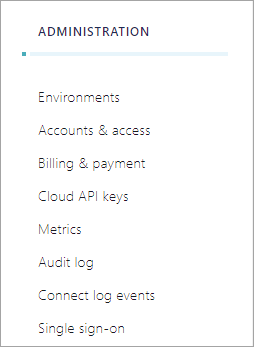
Access account and billing information from the Administration menu in the upper right corner of the Confluent Cloud Console. From there, you can also create API access keys.
How do I change my billing email address?
You can change your billing email address from the Payment details and contacts page in the Confluent Cloud Console, or you can contact your account team. The invoice can only be sent to a single email address. For step-by-step instructions, see Billing profile and payment.
Marketplace billing
What are Confluent Consumption Units?
Confluent Consumption Units (CCUs) are the billing units used in cloud marketplace deployments. Each CCU captures your Confluent Cloud usage based on underlying metrics such as data stored, ingress, egress, and other resource consumption. For current CCU pricing, see the marketplace listing. For detailed information about CCUs, see Manage Billing in Confluent Cloud. For marketplace setup guides, see Get Started with Confluent Cloud on the AWS Marketplace with Pay As You Go, Get Started with Confluent Cloud on the Google Cloud Marketplace with Pay as you Go, Get Started with Confluent Cloud on the Azure Marketplace with Pay As You Go, and Get Started with Confluent Cloud on the Jio Marketplace with Commitments.
How do I switch from direct Confluent billing to marketplace billing?
To switch from direct Confluent billing to marketplace billing, you can sign up through your preferred cloud provider’s marketplace. Follow the relevant guide for your cloud provider:
Can I use the same email address for marketplace signup if I already have a Confluent account?
No, Confluent Cloud requires your email address to be unique across all organizations. If you’ve previously registered for Confluent Cloud, you must use a different email address when signing up through a cloud marketplace. Alternatively, you can choose to link your existing account during the marketplace signup process.
What’s the difference between pay-as-you-go and commitment billing on marketplaces?
Pay-as-you-go billing charges monthly for actual usage with no commitment; commitment billing offers discounted rates in exchange for an annual minimum spend.
Pay-as-you-go billing: You pay monthly for only what you use with no upfront commitment.
Commitment billing: You make an annual commitment to a minimum spend amount in exchange for discounted rates. If you exceed your commitment, you continue to pay at the discounted rate. For more information about commitments, see Annual commitments.
What if I exceed my annual commitment?
If you exceed your annual commitment, you continue using Confluent Cloud at your discounted rate with no service interruption and no penalty for exceeding your committed amount. For more information, see Annual commitments.
What happens to my billing if my marketplace subscription is canceled?
If your marketplace subscription is canceled, Confluent Cloud access is suspended and eventually deactivated after a provider-specific grace period. You can restore access before deactivation by creating a new subscription through your cloud provider. For detailed information, see Marketplace Organization Suspension and Deactivation in Confluent Cloud.
Why don’t I see my cloud provider charges immediately?
If you’re using marketplace billing, your cloud provider may not show billed usage for Confluent Cloud until 6-24 hours after the usage occurred. This delay is normal for marketplace billing integrations. If charges still don’t appear after this window, contact your cloud provider’s billing support.
What if my organization is suspended or deactivated?
To reinstate a suspended account, create a new subscription through your cloud provider’s marketplace using the same billing account. The process varies by provider. If your account has already been deactivated, it cannot be recovered. For detailed instructions, see Marketplace Organization Suspension and Deactivation in Confluent Cloud.
Managing and reducing costs
How can I estimate my Confluent Cloud costs before getting started?
You can use the Confluent Cost Estimator to estimate your costs based on your expected usage. The estimator can explain how different factors like data volume, retention, and cluster type affect your costs. For more information about billing dimensions, see Billing Dimensions in Confluent Cloud.
What are the main factors that affect my Confluent Cloud bill?
Four main factors affect your Confluent Cloud bill: compute capacity, data transfer, storage, and additional services.
Compute capacity: CKUs for Dedicated clusters or eCKUs for Basic or Standard clusters
Storage: Total post-replication volume of data stored
Additional services: Connectors, ksqlDB, Schema Registry, Support plans
For detailed information about each billing dimension, see Billing Dimensions in Confluent Cloud.
How do I reduce my Confluent Cloud costs?
You can optimize costs by:
Configuring appropriate topic retention settings (
retention.bytesandretention.ms). For more information, see Configuration Reference for Topics in Confluent Cloud.Properly sizing your clusters based on actual usage. For more information, see CKU and eCKU.
Using data compression to reduce storage and transfer costs.
Considering annual commitments for volume discounts. For more information, see Annual commitments.
How long does it take for usage to appear on my bill?
Usage appears in the Confluent Cloud Console immediately, but cost data can take up to 72 hours to become available through the Costs API.
Viewing your bill
How do I view my organization bill and ID in Cloud Console?
To view your organization bill and Cloud Organization ID, open the Administration menu in Cloud Console and go to Billing and payment. The Billing page shows current accrued charges, and the Payment details and contacts tab shows your Cloud Organization ID. For step-by-step instructions, see Billing profile and payment.
How do I download detailed billing information?
You can download billing information as a CSV file from the Billing and payment screen in Confluent Cloud Console. For programmatic access, use the Costs API. For detailed instructions, see View or download invoices and Retrieve costs for a range of dates.
How does Confluent Support billing work?
You pay the higher of a minimum monthly charge or a percentage of your total Confluent Cloud usage costs. The percentage applies when it exceeds the minimum. Support charges count toward your annual commitment. For detailed information, see Confluent support plans.