Salesforce Source V2 Connector for Confluent Cloud
The fully managed Salesforce Source V2 connector for Confluent Cloud streams data from Salesforce to Apache Kafka® topics with zero data loss. The connector supports real-time Change Data Capture (CDC) events using the Pub/Sub API and periodic polling using the Bulk API 2.0. Additionally, you can configure an optional initial historical load using the Bulk API 2.0.
Features
The Salesforce Source V2 connector provides the following features:
Real-time ingestion modes: The connector supports an optional historical snapshot for initial data loads using Bulk API 2.0. For real-time ingestion, configure one of the following modes:
Event-Driven Sync: Streams real-time CDC events using the Pub/Sub API. This is the default real-time ingestion mode.
Periodic Polling: Periodically polls Salesforce for changes using Bulk API 2.0.
When the historical snapshot is enabled, the connector automatically transitions from snapshot to real-time ingestion on the same Kafka topic with zero data loss.
Multi-SObject ingestion: The connector ingests data from up to five Salesforce SObjects per connector instance, each with its own Kafka topic and independent Pub/Sub channel. Topics follow the naming pattern
{prefix}.{SObject}, for example,salesforce.Account. The connector processes each SObject with independent state — schema cache, offsets, bulk job, and Pub/Sub subscription — so each SObject’s progress and failures are isolated.Modern Pub/Sub API: The connector uses Salesforce’s recommended Pub/Sub API, which uses gRPC, HTTP/2, and binary Avro encoding, instead of the legacy CometD-based Streaming API.
Full record retrieval on update: By default, CDC
UPDATEevents emit only the changed fields, following Salesforce’s partial-payload semantics. Whencdc.full.record.on.updateis set totrue, the connector calls the Salesforce REST API once perUPDATEevent to fetch the complete post-image of the record and emits all field values to Kafka. CDCCREATEevents already carry the full new record, andDELETEevents have no field payload, so this option affects onlyUPDATEevents, and only whenreal.time.ingestion.modeis set toEvent-Driven Sync (using Pub/Sub API). The option is suited for low-to-moderate update volumes because of the extra REST API call perUPDATEevent. High-throughput organizations can exhaust their Salesforce daily API quota.GAP event reconciliation: The connector automatically detects GAP events, which are notifications from the Pub/Sub API that it missed events. For more information, see Gap events in the Salesforce documentation. The connector handles these events according to the
gap.event.recoveryproperty:Resync (the default): The connector switches the affected SObject to an incremental Bulk API 2.0 re-sync to recover missed events while other SObjects continue streaming without interruption. To determine the re-sync start time, the connector selects the later timestamp between the commit time of the last successful CDC event and the completion time of the historical snapshot, and then subtracts a safety buffer. For example, if the last event occurs at 10:15 AM, the snapshot finishes at 10:00 AM, and the safety buffer is 5 minutes, the connector selects 10:15 AM and subtracts the buffer to start the re-sync at 10:10 AM.
Latest: Skips the gap and resubscribes from the newest available events. Events that occur during the gap are lost.
Fail: Stops the task for manual intervention.
If a GAP event arrives before the connector has any watermark to anchor against — for example, when the historical snapshot is disabled and no CDC events have been emitted yet — the
Resyncpolicy falls back to a full table re-fetch using Bulk API 2.0 to guarantee coverage. This prevents data loss but can be expensive on large SObjects.Streaming initial start: The
event.sync.start.pointproperty controls the replay position when a Pub/Sub streaming subscription opens with no stored replay ID. This is the case on a cold start or after the offsets are reset or deleted. As soon as the connector emits an event, it stores that event’s replay ID in its offsets and, on any subsequent restart, resumes from the stored replay ID using theCUSTOMpreset —event.sync.start.pointis not consulted in that case. Note that resetting or deleting the connector’s offsets removes the stored replay ID, so the next start again falls back toevent.sync.start.point.latest: The default. Opens with the Salesforce
LATESTpreset, starting from new events only.all: Opens with the Salesforce
EARLIESTreplay preset, replaying everything still in the 72-hour Pub/Sub retention buffer.
Changed and null field detection: The connector identifies changed and nulled fields by decoding Salesforce CDC hex bitmaps. It exposes the resolved field names as Kafka record headers:
source.changed.fields: comma-separated names of fields whose value changed.cdc.nulled.fields: comma-separated names of fields explicitly set to null.
Downstream consumers such as Flink SQL and ksqlDB can use these headers to distinguish “field unchanged” from “field set to null”.
CSFLE and CSPE support: The connector supports Client-Side Field Level Encryption (CSFLE) and client-side per-event encryption (CSPE) for sensitive data. For more information about CSFLE or CSPE setup, see the connector configuration.
Supported data formats: The connector supports Avro, JSON Schema, and Protobuf output data. You must enable Schema Registry to use a Schema Registry-based format, for example, Avro, JSON_SR (JSON Schema), or Protobuf.
Configurable date and datetime representation: By default, the connector emits Salesforce date and datetime fields as epoch milliseconds. To keep them as ISO 8601 strings, list the field names in
skip.epoch.conversion.fields. Changing this list alters the Connect schema type for those fields —int64for epoch milliseconds,stringfor ISO 8601 — so ensure your Schema Registry compatibility settings allow the resulting schema evolution.Tombstone records: When
emit.tombstone.on.deleteis set totrue,DELETECDC events produce tombstone records with a null value and non-null key for Kafka topic compaction. The default isfalse.Soft-delete handling: When
include.deleted.recordsis set totrue, the connector uses the Bulk APIqueryAllcall to include soft-deleted records in historical snapshot and periodic polling modes. In CDC modes, the Pub/Sub API surfaces deletes asDELETEevents.Automatic retries: The connector classifies each error by HTTP or gRPC status and retries transient failures with exponential backoff and jitter. Transient failures include:
HTTP 429 and 5xx responses.
Bulk API daily-quota responses such as HTTP 403
REQUEST_LIMIT_EXCEEDED.Responses with gRPC status
UNAVAILABLE,DEADLINE_EXCEEDED, orRESOURCE_EXHAUSTED.Network timeouts.
The total retry budget is capped by
request.max.retries.time.ms, which defaults to 30 seconds.Offset management: The connector supports custom offset management. For more information, see Manage custom offsets.
Supports OAuth 2.0 Authorization Code grant flow (BYOA): The connector supports authentication using the OAuth 2.0 Authorization Code grant flow with your own connected application or external client application (bring your own app), which helps you connect to Salesforce without exposing user credentials. To use the
OAUTH2_AUTH_CODE_BYOAgrant type, provide your application’s consumer key and consumer secret, then complete the authorization by clicking Connect with Salesforce. A shared application is not supported.
Supports Salesforce External Client Apps (ECA): This connector supports Salesforce External Client Apps when using the
JWT_BEARER,OAUTH2_AUTH_CODE_BYOA, orCLIENT_CREDENTIALSgrant type.
For more information and examples to use with the Confluent Cloud API for Connect, see the Confluent Cloud API for Connect Usage Examples section.
Historical snapshot to streaming handoff
When historical.snapshot is set to true and real.time.ingestion.mode
is set to Event-Driven Sync (using Pub/Sub API), the connector performs a one-time historical
backfill using Bulk API 2.0 and then sustains real-time replication using the
Pub/Sub API for Change Data Capture. The snapshot and streaming phases overlap in time, so
the handoff requires no manual intervention.
Avoiding event loss at the start of streaming
While the bulk job runs, the connector opens a parallel Pub/Sub subscription
with the LATEST preset as a one-shot probe. On the first event, the
connector stores the replayId in the offset and closes the subscription.
At handoff to event-driven sync, the connector opens a fresh subscription
with the CUSTOM preset using the stored replayId, so streaming resumes
at or before the point the snapshot ended. No events are lost between the end
of the bulk job and the start of streaming.
Avoiding duplicate events at the handoff
The brief overlap between the snapshot and streaming phases is protected by a deduplication watermark. When the bulk job completes, the connector records the snapshot completion timestamp, which is the upper bound of the last bulk job. Any Change Data Capture event whose change timestamp is strictly before the snapshot completion timestamp is dropped, because the snapshot already captured that record’s latest state.
GAP event recovery resync
When a GAP event arrives and gap.event.recovery is set to
resync, the connector switches the affected SObject to a
Bulk API 2.0 re-sync to fetch the missed events. The re-sync starting
point depends on whether a CDC event has been emitted for the SObject:
Last commit time stored: At least one CDC event has been emitted for the SObject. The connector re-syncs from the commit time of the latest emitted CDC event, minus a safety buffer set by
gap.resync.buffer.ms, which defaults to 60 seconds. This is the tightest possible re-fetch.No last commit time: No CDC event has been emitted yet. The connector falls back to the snapshot completion timestamp minus
gap.resync.buffer.ms, re-fetching everything since the snapshot ended.
Limitations
Review the following:
For connector limitations, see Salesforce Source V2 connector.
If you plan to use one or more Single Message Transformations (SMTs), see SMT Limitations.
Manage custom offsets
You can manage the offsets for this connector. Offsets provide information on the point in the system from which the connector is accessing data. For more information, see Manage Offsets for Fully Managed Connectors in Confluent Cloud.
To manage offsets:
Manage offsets using Confluent Cloud APIs. For more information, see Connect offsets API reference.
The Salesforce Source V2 connector emits one offset entry per Salesforce
SObject. Each entry tracks the SObject’s progress through the connector’s
loading lifecycle. The mode field has three values:
Historical SnapshotPeriodic PollingEvent-Driven Sync
To get the current offset, make a GET request that specifies the
environment, Kafka cluster, and connector name.
GET /connect/v1/environments/{environment_id}/clusters/{kafka_cluster_id}/connectors/{connector_name}/offsets
Host: https://api.confluent.cloud
Response:
Successful calls return HTTP 200 with a JSON payload that describes
the offset.
{
    "id": "lcc-example123",
    "name": "{connector_name}",
    "offsets": [
      {
        "partition": {
          "sobject": "Contact"
        },
        "offset": {
          "commitNumber": 1779986819752870000,
          "commitTimestamp": 1779986819000,
          "mode": "Event-Driven Sync",
          "offset.version": 1,
          "replayId": "AAAAAAARXWcAAA==",
          "snapshotCompletionTimestamp": 1779986505317
        }
      },
      {
        "partition": {
          "sobject": "Account"
        },
        "offset": {
          "lastId": "001gL00001MoGikQAF",
          "lastSystemModstamp": "2026-05-27T05:48:54.000Z",
          "mode": "Historical Snapshot",
          "offset.version": 1,
          "snapshotCompletionTimestamp": 1779986499361
        }
      }
    ],
    "metadata": {
        "observed_at": "2026-05-28T16:48:53.969580851Z"
    }
}
Responses include the following information:
The current loading phase of each SObject, represented by
modein the offset payload.The position within that phase. For the Bulk API-based modes, such as
Historical SnapshotandPeriodic Polling, the position is represented bylastSystemModstamp,lastId,jobId, andlocator. ForEvent-Driven Sync, the position is represented bysnapshotCompletionTimestamp,replayId,commitTimestamp, andcommitNumber.The observed time of the offset in the metadata portion of the payload. The
observed_attime indicates a snapshot in time for when the API retrieved the offset.Information about the connector.
To update the offset, make a POST request that specifies the
environment, Kafka cluster, and connector name. Include a JSON payload
that specifies the new offset and a patch type.
POST /connect/v1/environments/{environment_id}/clusters/{kafka_cluster_id}/connectors/{connector_name}/offsets/request
Host: https://api.confluent.cloud

 {
     "type": "PATCH",
     "offsets": [
       {
         "partition": { "sobject": "Contact" },
         "offset": {
           "offset.version": 1,
           "mode": "Event-Driven Sync",
           "snapshotCompletionTimestamp": 1777904179496,
           "replayId": "AAAAAAAAALY=",
           "commitTimestamp": 1777904180123,
           "commitNumber": 12345
         }
       }
     ]
 }
Considerations:
You can only make one offset change at a time for a given connector.
This is an asynchronous request. To check the status of this request, you must use the check offset status API. For more information, see Get the status of an offset request.
For source connectors, the connector attempts to read from the position defined by the requested offsets. For the Salesforce Source V2 connector, the
modefield in the offset determines the position:Historical Snapshotcontinues the initial Bulk API 2.0 historical backfill fromlastSystemModstampandlastId. When those fields are empty, the snapshot starts from thesinceconfiguration.Periodic Pollingcontinues incremental Bulk polling fromlastSystemModstampandlastId.Event-Driven Syncresumes Pub/Sub event consumption fromreplayId.A
PATCHupdates only the SObjects listed in the request. Omitted SObjects are unaffected. To reset a single SObject without disturbing others, send a null offset for that SObject’s partition.The
replayIdfield is the base64-encoded Salesforce Pub/Sub replay ID for the last consumed CDC event. For more information, see Replay in the Salesforce Pub/Sub API documentation.The connector discards events outside the 72-hour Salesforce retention period. If the requested
replayIdfalls outside the retention window, the connector applies the policy configured bygap.event.recovery.PATCHing
modetoHistorical Snapshothas no effect in pure streaming mode, that is, whenhistorical.snapshotisfalseandreal.time.ingestion.modeisEvent-Driven Sync (using Pub/Sub API). The connector forces streaming at startup regardless of the offset’smode. Update the connector configuration to enablehistorical.snapshotif you need to run a Bulk snapshot.
Response:
Successful calls return HTTP 202 Accepted with a JSON payload that
describes the offset.
{
    "id": "lcc-example123",
    "name": "{connector_name}",
    "offsets": [
      {
        "partition": {
          "sobject": "Contact"
        },
        "offset": {
          "commitNumber": 12345,
          "commitTimestamp": 1777904180123,
          "mode": "Event-Driven Sync",
          "offset.version": 1,
          "replayId": "AAAAAAAAALY=",
          "snapshotCompletionTimestamp": 1777904179496
        }
      }
    ],
    "requested_at": "2026-05-28T16:51:39.735139217Z",
    "type": "PATCH"
}
Responses include the following information:
The requested position of the offsets in the source.
The time of the request to update the offset.
Information about the connector.
To delete the offset, make a POST request that specifies the
environment, Kafka cluster, and connector name. Include a JSON payload
that specifies the delete type.
 POST /connect/v1/environments/{environment_id}/clusters/{kafka_cluster_id}/connectors/{connector_name}/offsets/request
 Host: https://api.confluent.cloud

{
  "type": "DELETE"
}
Considerations:
Delete requests delete the offset for the provided partition and reset to the base state. A delete request resets the connector to its base state, equivalent to creating a new connector.
A
DELETEresets the offsets for all SObjects tracked by the connector. To reset a single SObject, send a per-partition null offset using aPATCHrequest instead.This is an asynchronous request. To check the status of this request, you must use the check offset status API. For more information, see Get the status of an offset request.
Do not issue delete and patch requests at the same time.
For source connectors, the connector attempts to read from the position defined in the base state.
Response:
Successful calls return HTTP 202 Accepted with a JSON payload that
describes the result.
{
  "id": "lcc-example123",
  "name": "{connector_name}",
  "offsets": [],
  "requested_at": "2026-05-04T14:55:15.179333302Z",
  "type": "DELETE"
}
Responses include the following information:
Empty offsets.
The time of the request to delete the offset.
Information about Kafka cluster and connector.
The type of request.
To get the status of a previous offset request, make a GET request
that specifies the environment, Kafka cluster, and connector name.
GET /connect/v1/environments/{environment_id}/clusters/{kafka_cluster_id}/connectors/{connector_name}/offsets/request/status
Host: https://api.confluent.cloud
The status endpoint always shows the status of the most recent
PATCH or DELETE operation.
Response:
Successful calls return HTTP 200 with a JSON payload that describes
the result. The following example shows an applied delete.
{
   "request": {
      "id": "lcc-example123",
      "name": "{connector_name}",
      "offsets": [],
      "requested_at": "2026-05-04T14:55:15.179333302Z",
      "type": "DELETE"
   },
   "status": {
      "phase": "APPLIED",
      "message": "The offsets for this connector have been reset successfully."
   },
   "previous_offsets": [
     {
       "partition": {
         "sobject": "Contact"
       },
       "offset": {
         "commitNumber": 12345,
         "commitTimestamp": 1777904180123,
         "mode": "Event-Driven Sync",
         "offset.version": 1,
         "replayId": "AAAAAAAAALY=",
         "snapshotCompletionTimestamp": 1777904179496
       }
     },
     {
       "partition": {
         "sobject": "Account"
       },
       "offset": {
         "lastId": "001gL00001MoGikQAF",
         "lastSystemModstamp": "2026-05-27T05:48:54.000Z",
         "mode": "Historical Snapshot",
         "offset.version": 1,
         "snapshotCompletionTimestamp": 1779986499361
       }
     }
   ],
   "applied_at": "2026-05-04T14:55:34.115765732Z"
}
Responses include the following information:
The original request, including the time it was made.
The status of the request: applied, pending, or failed.
The time you issued the status request.
The previous offsets, which represent the offset state before the most recent update. Use these to restore the state of your connector if a patch update causes your connector to fail, or to return a connector to its previous state after rolling back.
JSON payload
The following table describes the unique fields in the JSON payload for managing offsets of the Salesforce Source V2 connector.
Field |
Definition |
Required or optional |
|---|---|---|
|
The current loading phase of the SObject. Valid values are
|
Required |
|
Offset schema version. Always |
Required |
|
Salesforce record ID of the last ingested record (15 or 18
characters). Used in |
Optional |
|
Timestamp of the last ingested record, formatted as
|
Optional |
|
Bulk API 2.0 job ID of an in-flight query job. Empty string when no job is currently active. Present on offsets emitted during the snapshot-style modes when the connector is mid-Bulk-poll. |
Optional |
|
Bulk API 2.0 result locator for paginated reads of an in-flight job. Empty string when no job is currently active. |
Optional |
|
Unix timestamp in milliseconds when the Bulk snapshot completed. |
Optional |
|
Base64-encoded Salesforce Pub/Sub API replay ID for the last consumed
CDC event. Used in |
Optional |
|
Unix timestamp in milliseconds of the last consumed CDC event commit.
Used in |
Optional |
|
Salesforce commit number of the last consumed CDC event. Used in
|
Optional |
Set up Salesforce authentication
Important
Confluent has deprecated the OAuth 2.0 username-password flow
(salesforce.grant.type=PASSWORD) for Salesforce connectors,
following Salesforce’s retirement notice.
Salesforce begins enforcing this retirement on February 20, 2027
(delayed from the originally announced Winter ‘27 timeline). After
that date, connectors that use the PASSWORD grant type can’t
authenticate to Salesforce. Salesforce organizations created in
Summer ‘26 or later already can’t use this flow. Before February 20,
2027, update your connector configuration to use the JWT_BEARER,
CLIENT_CREDENTIALS, or OAUTH2_AUTH_CODE_BYOA grant type.
Salesforce connectors authenticate with Salesforce through a connected application or External Client App (ECA). A connected application is a metadata object in Salesforce that defines the protocol (OAuth), the permissions (scopes), and the security policies (for example, IP relaxation and user authorization) for an external application. The consumer key (client ID) and consumer secret (client secret) that you enter in the connector configuration are the credentials of this connected application.
The connector supports the following OAuth 2.0 grant types. You select the
grant type using the salesforce.grant.type configuration property.
CLIENT_CREDENTIALS: The connector authenticates with only the consumer key and consumer secret of the connected application. User credentials are not transmitted.JWT_BEARER: The connector authenticates with a JSON Web Token (JWT) signed with a private key.OAUTH2_AUTH_CODE_BYOA: The connector uses the OAuth 2.0 authorization code flow with an application you create and own in your Salesforce org (bring your own application, or BYOA). Confluent Cloud stores a refresh token issued during a one-time browser authorization and uses it to obtain access tokens at runtime.
Client Credentials flow
The OAuth 2.0 Client Credentials flow enables the connector to connect to
Salesforce without exposing user credentials. Salesforce requires an
execution user (the Run As user) for this flow. If no Run As user is
defined in the connected application policies, authentication fails with an
invalid_grant or no client credentials user enabled error.
Configure Salesforce
Complete the following steps in Salesforce before you create the connector.
Enable the client credentials flow:
If you don’t already have a connected application for the connector, enable connected app creation first. Navigate to Setup > External Client App Settings and enable Allow creation of connected apps. This setting is hidden by default in new Salesforce organizations.
Navigate to Setup > App Manager.
Locate the connected application used for the connector, click the drop-down arrow, and select Edit.
Under API (Enable OAuth Settings), select Enable Client Credentials Flow. This option is often disabled by default for older applications.
Save the application definition.
Assign the execution user:
Navigate to Setup > Manage Connected Apps, which is distinct from App Manager.
Click the name of the connected application.
Click Edit Policies.
Scroll to the Client Credentials Flow section.
In Run As, click the search icon and select the dedicated integration user (for example,
integration.user@example.com).The Run As user must have the API Enabled permission and enough rights to access the objects the connector reads from or writes to.
Configure the connector
Set the following authentication properties in the connector configuration.
Configuration property |
Value |
Notes |
|---|---|---|
|
|
Select this grant type explicitly. |
|
Consumer key of the connected application. |
Also called the client ID. |
|
Consumer secret of the connected application. |
Also called the client secret. |
|
|
You must use your My Domain URL. The default value
|
|
Not used. |
The execution user is defined in Salesforce. |
|
Not used. |
The execution user is defined in Salesforce. |
The client credentials flow requires your My Domain URL, for example,
https://<your-domain>.my.salesforce.com, in the salesforce.instance
property. When a client credentials request is sent to the generic
https://login.salesforce.com endpoint, the Salesforce global router
might fail to identify the tenant-specific policies required to look up the
Run As user mapping, and authentication fails.
JWT Bearer flow
The OAuth 2.0 JWT bearer flow establishes trust through public-key
cryptography and is the recommended authentication method for production
environments. The connector
signs a JWT with its private key, identifying the Salesforce user in the
sub (subject) claim. Salesforce validates the signature using the
public certificate uploaded to the connected application and issues an access
token. The flow requires no interactive login or password, and is not
affected by password expiration policies.
Configure JWT Bearer
Complete the following steps to configure the JWT bearer flow.
Generate a private key and certificate: Generate a private key and a self-signed certificate using OpenSSL. The following example sets the certificate validity to 3,650 days (10 years) to reduce maintenance overhead.
openssl req -newkey rsa:2048 -nodes -keyout private.key -x509 \
   -days 3650 -out public.crt
The command generates the following files:
private.key: The private key the connector uses to sign the JWT.public.crt: The public certificate you upload to Salesforce.
Create the Java keystore (JKS): The connector requires the private key in a JKS container and cannot read the raw PEM files directly.
Convert the certificate and private key to PKCS12 format:
openssl pkcs12 -export -in public.crt -inkey private.key \
   -out keystore.p12 -name salesforce-cert
You are prompted to create an export password. This password becomes the keystore password used in the connector configuration.
Import the PKCS12 file into a JKS keystore:
keytool -importkeystore -srckeystore keystore.p12 \
   -srcstoretype pkcs12 -destkeystore salesforce.jks \
   -deststoretype JKS
Upload the resulting
salesforce.jksfile when you configure the connector.
Configure the Salesforce connected application
Complete the following steps in Salesforce before you create the connector.
If you don’t already have a connected application for the connector, enable connected app creation first. Navigate to Setup > External Client App Settings and enable Allow creation of connected apps. This setting is hidden by default in new Salesforce organizations.
Navigate to Setup > App Manager and edit the connected application used for the connector.
Under API (Enable OAuth Settings), select Use digital signatures, click Choose File, and upload the
public.crtfile.Ensure the
api,refresh_token, andoffline_accessOAuth scopes are selected.Pre-authorize users. Navigate to Setup > Manage Connected Apps, click Edit Policies, and change Permitted Users to Admin approved users are pre-authorized. The JWT Bearer flow is automated, and the connector cannot approve a consent screen, so you must be pre-authorized.
Assign profiles. In Manage Connected Apps, scroll to Profiles (or Permission Sets) and add the profile of the integration user, for example, a custom integration profile.
Configure the connector
Set the following authentication properties in the connector configuration.
Configuration property |
Value |
Notes |
|---|---|---|
|
|
Select this grant type explicitly. |
|
Consumer key of the connected application. |
Also called the client ID. |
|
Username of the integration user |
Sets the |
|
The |
Upload the file when you configure the connector. |
|
Keystore password |
The export password set during the PKCS12 conversion. |
|
|
Use your My Domain URL for best results. |
|
Not used |
Not required for this grant type. |
|
Not used |
The signed JWT replaces the consumer secret. |
Troubleshoot authentication errors
The following table lists common authentication errors and how to resolve them.
Error |
Grant type |
Probable cause |
Resolution |
|---|---|---|---|
|
|
No Run As user is defined for the connected application. |
Define the execution user in the connected application policies. |
|
|
Wrong instance URL. |
Set |
|
|
The user is not admin-approved to access the connected application. |
In Manage Connected Apps, open the connected application, click Manage Profiles, and add the profile of the integration user. |
|
All grant types |
Wrong consumer key or consumer secret. |
Verify the consumer key and consumer secret. Check for trailing spaces. |
|
|
Wrong audience in the JWT claim. |
Ensure |
|
All grant types |
The network blocks the connection. |
Check firewall and proxy settings, and verify that the Salesforce URL is reachable. |
|
|
The Client Credentials flow is disabled for the connected application. |
In App Manager, edit the connected application and select Enable Client Credentials Flow. |
|
All grant types |
The integration user has insufficient permissions. |
Grant the integration user the API Enabled permission and create and read permissions on the target objects. |
|
|
The refresh token expired, was revoked, or was rotated. |
Manually re-authorize with Connect with Salesforce, and preferably set the refresh token policy to Valid Until Revoked and disable refresh token rotation. |
|
|
Salesforce allows only five unique OAuth approvals per user per connected application. Each refresh token counts as an approval, and a new approval beyond the limit revokes the oldest. Sharing one Salesforce user and connected application across multiple connectors (or re-authorizing repeatedly) exhausts this limit and revokes an older connector’s refresh token. |
Use a dedicated Salesforce user for each connector (a shared connected application is fine as long as the user differs), and avoid unnecessary re-authorizations. Then re-authorize the affected connector with Connect with Salesforce. For more information, see Salesforce’s Manage OAuth-Enabled Connected Apps’ Access documentation. |
Quick start
Use this quick start to get up and running with the Confluent Cloud Salesforce Source V2 connector. The quick start provides the basics of selecting the connector and configuring it to stream events from Salesforce to Kafka topics.
If you’re migrating from the Salesforce Bulk API 2.0 Source or Salesforce CDC Source connector, see Migrate from Salesforce Bulk API 2.0 Source or CDC Source to Salesforce Source V2.
- Prerequisites
Authorized access to a Confluent Cloud cluster on Amazon Web Services (AWS), Microsoft Azure (Azure), or Google Cloud.
A Salesforce account with View All Data, API Enabled, View Setup and Configuration, and Read access to the target objects. When
real.time.ingestion.modeis set toEvent-Driven Sync (using Pub/Sub API), explicitly enable Change Data Capture for every SObject listed insobject.names. OAuth2 Client Credentials or JWT Bearer authentication must be configured in Salesforce.The Confluent CLI installed and configured for the cluster. For installation steps, see Install the Confluent CLI.
Schema Registry must be enabled to use a Schema Registry-based format, for example, Avro, JSON_SR (JSON Schema), or Protobuf.
For networking considerations, see Networking and DNS. To use a set of public egress IP addresses, see Public Egress IP Addresses for Confluent Cloud Connectors.
Kafka cluster credentials. The following lists the different ways you can provide credentials.
Enter an existing service account resource ID.
Create a Confluent Cloud service account for the connector. Make sure to review the ACL entries required in the service account documentation. Some connectors have specific ACL requirements.
Create a Confluent Cloud API key and secret. To create a key and secret, you can use confluent api-key create or you can autogenerate the API key and secret directly in the Cloud Console when setting up the connector.
Using the Confluent Cloud Console
Step 1: Launch your Confluent Cloud cluster
To create and launch a Kafka cluster in Confluent Cloud, see Create a kafka cluster in Confluent Cloud.
Step 2: Add a connector
In the left navigation menu, click Connectors. If you already have connectors in your cluster, click + Add connector.
Step 3: Select your connector
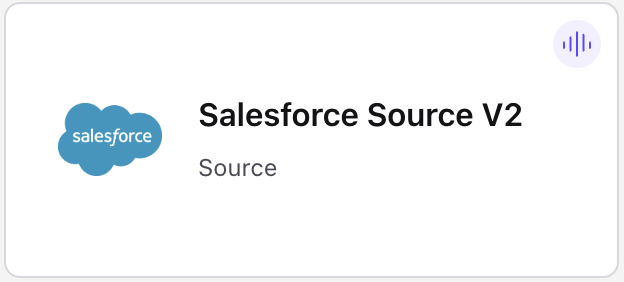
Click the Salesforce Source V2 connector card.
Step 4: Enter the connector details
Ensure you have all your prerequisites completed. An asterisk ( * ) designates a required entry.
At the Add Salesforce Source V2 Connector screen, complete the following:
Select the topic you want to send data to from the Topics list.
To create a new topic, click +Add new topic.
Select the way you want to provide Kafka Cluster credentials. You can choose one of the following options:
My account: This setting allows your connector to globally access everything that you have access to. With a user account, the connector uses an API key and secret to access the Kafka cluster. This option is not recommended for production.
Service account: This setting limits the access for your connector by using a service account. This option is recommended for production.
Use an existing API key: This setting allows you to specify an API key and a secret pair. You can use an existing pair or create a new one. This method is not recommended for production environments.
Note
Freight clusters support only service accounts for Kafka authentication.
Click Continue.
Configure the authentication properties:
Salesforce grant type (username-password deprecated): Grant type the connector uses for Salesforce authentication:
PASSWORD,CLIENT_CREDENTIALS,JWT_BEARER, orOAUTH2_AUTH_CODE_BYOA(OAuth 2.0 Authorization Code with your own connected app).Note
The
PASSWORDgrant type relies on the Salesforce OAuth 2.0 Username-Password flow, which Salesforce is retiring in Spring ‘27. Migrate existing configurations to other supported authentication methods.
Salesforce details
Salesforce instance: The URL of the Salesforce endpoint to use. When using the
CLIENT_CREDENTIALSgrant type, provide your Salesforce domain URL. The default ishttps://login.salesforce.com, which directs the connector to use the endpoint specified in the authentication response.Salesforce username: The Salesforce username the connector uses.
Salesforce password: The Salesforce password the connector uses.
Salesforce password token: The Salesforce security token associated with the username.
Salesforce consumer key: The client ID (consumer key) for the Salesforce Connected App.
Salesforce consumer secret: The client secret (consumer secret) for the Salesforce Connected App.
Salesforce JWT keystore file: The Salesforce JWT keystore file that contains the private key.
Salesforce JWT keystore password: The password the connector uses to access the JWT keystore file.
Note
The following properties are used based on the Salesforce grant type you choose.
JWT_BEARER: Requires username, consumer key, JWT keystore file, and JWT keystore password.PASSWORD: Requires username, password, password token, consumer key, and consumer secret.CLIENT_CREDENTIALS: Requires the client ID and client secret of a Salesforce connected application as the consumer key and consumer secret, and the Salesforce domain URL in the Salesforce instance option. The default value https://login.salesforce.com does not work for this option. To useCLIENT_CREDENTIALS, you must enable the Client Credentials flow in your connected Salesforce application and assign an integration user.OAUTH2_AUTH_CODE_BYOA: Requires consumer key and consumer secret (the consumer key and consumer secret of your Salesforce connected application or external client application). After you enter these values, complete the authorization by clicking Connect with Salesforce to perform the OAuth 2.0 handshake and store the refresh token. Only bring your own application (BYOA) is supported. A shared application is not supported. Confluent recommends using the My Domain URL, although the default URLs also work.
Click Continue.
Properties not shown in the Cloud Console use the default values. For all property values and definitions, see Configuration properties.
Select output record value format: Sets the output Kafka record value format. Valid entries are
AVRO,JSON_SR, orPROTOBUF.Note
You need to have Confluent Cloud Schema Registry configured if using a schema-based message format like
AVRO,JSON_SR, orPROTOBUF.
Historical snapshot
Historical snapshot: When enabled, the connector uses Bulk API 2.0 to retrieve existing Salesforce records starting from the Since date.
Since: Specifies the
CreatedDateinyyyy-MM-ddformat from which the connector pulls existing Salesforce records. Applies only when historical snapshot is enabled and defaults to today.
Real-time ingestion
Real-time ingestion mode: Select the mode for continuous ingestion: Periodic Polling using Bulk API 2.0 or Event-Driven Sync using Pub/Sub API.
Topic prefix: Prefix added to topic names for multi-SObject configuration, for example,
prefix.Accountorprefix.Contact.SObject names: Comma-separated list of Salesforce SObjects to ingest, such as
Account,Contact, orLead.
Data encryption
Enable Client-Side Field Level Encryption for data encryption. Specify a Service Account to access the Schema Registry and associated encryption rules or keys with that schema. For more information on CSFLE or CSPE setup, see Manage encryption for connectors.
Show advanced configurations
Schema context: Select a schema context to use for this connector, if using a schema-based data format. This property defaults to the Default context, which configures the connector to use the default schema set up for Schema Registry in your Confluent Cloud environment. A schema context allows you to use separate schemas (like schema sub-registries) tied to topics in different Kafka clusters that share the same Schema Registry environment. For example, if you select a non-default context, a Source connector uses only that schema context to register a schema and a Sink connector uses only that schema context to read from. For more information about setting up a schema context, see What are schema contexts and when should you use them?.
Event sync start point: When set to
all, the connector replays buffered events from up to the last 72 hours. When set tolatest, it streams the latest events only.Gap event recovery: Defines what happens when the connector detects missed streaming events (gap events). Choose
resyncto run an incremental Bulk API resync from the last record’s commit timestamp,latestto skip missed events and continue from latest events only, orfailto stop the connector task.Full record on update: When enabled, CDC update events read full records instead of only changed fields. Applies only to
Event-Driven Syncmode.Emit tombstone on delete: When enabled, delete events emit Kafka tombstones. Applies only to
Event-Driven Syncmode.Gap resync safety buffer (ms): Safety buffer in milliseconds that the connector subtracts from the last commit time during incremental Bulk API resync. Applies only when gap event recovery is set to
resync. For tuning guidance, see the Salesforce Source V2 connector documentation.Poll interval (ms): Set the time in milliseconds to wait for new change events when no data is returned. Default is
500ms.Max records per result set: Maximum number of records returned per Bulk API 2.0 result set across all SObjects. The default is
1000.Include deleted records: Whether Bulk API queries must include soft-deleted records by using
queryAll.Skip epoch conversion fields: Date or datetime field names that stay as ISO 8601 strings instead of epoch milliseconds across all SObjects.
Additional Configs
value.converter.replace.null.with.default: Whether to replace fields that have a default value and that are null to the default value. When set to true, the default value is used, otherwise null is used. Applicable for JSON Converter.
Value Converter Reference Subject Name Strategy: Sets the subject reference name strategy for values. Valid entries are
DefaultReferenceSubjectNameStrategyorQualifiedReferenceSubjectNameStrategy. You can use this strategy only withPROTOBUFformat; the default strategy isDefaultReferenceSubjectNameStrategy.value.converter.schemas.enable: Include schemas within each of the serialized values. Input messages must contain schema and payload fields and may not contain additional fields. For plain JSON data, set this to false. Applicable for JSON Converter.
errors.tolerance: Use this property if you would like to configure the connector’s error handling behavior. WARNING: This property should be used with CAUTION for SOURCE CONNECTORS as it may lead to dataloss. If you set this property to ‘all’, the connector will not fail on errant records, but will instead log them (and send to DLQ for Sink Connectors) and continue processing. If you set this property to ‘none’, the connector task will fail on errant records.
value.converter.ignore.default.for.nullables: When set to true, this property ensures that the corresponding record in Kafka is NULL, instead of showing the default column value. Applicable for AVRO,PROTOBUF and JSON_SR Converters.
Value Converter Decimal Format: Specifies the
JSONorJSON_SRserialization format for ConnectDECIMALlogical type values with two allowed literals:BASE64to serializeDECIMALlogical types as base64 encoded binary data, andNUMERICto serializeDECIMALlogical type values inJSONorJSON_SRas a number representing the decimal value.Key Converter Schema ID Serializer: The class name of the schema ID serializer for keys. This is used to serialize schema IDs in the message headers.
Value Converter Connect Meta Data: Enables the Connect converter to add its metadata to the output schema. Applies to Avro converters.
Value Converter Value Subject Name Strategy: Determines how to construct the subject name under which the value schema is registered with Schema Registry.
Key Converter Key Subject Name Strategy: Determines how to construct the subject name for key schema registration.
Value Converter Schema ID Serializer: The class name of the schema ID serializer for values. This is used to serialize schema IDs in the message headers.
Auto-restart policy
Enable Connector Auto-restart: Enables the auto-restart behavior of the connector and its task in the event of user-actionable errors. Defaults to
true, enabling the connector to automatically restart in case of user-actionable errors. Set this property tofalseto disable auto-restart for failed connectors. If disabled, you must manually restart the connector.
Connection details
Max retry time (ms): Maximum time in milliseconds until the connector stops retrying failed Salesforce requests. Default is
30000and minimum is1000.
Transforms
Single Message Transformations: To add a new SMT, see Add transforms. For more information about unsupported SMTs, see Unsupported transformations.
Processing position
Set offsets: Click Set offsets to define a specific offset for this connector to begin procession data from. For more information on managing offsets, see Manage offsets.
For all property values and definitions, see Configuration properties.
Click Continue.
Tasks are distributed across SObjects using round-robin assignment. Each
task owns its assigned SObjects through both the snapshot and streaming
phases. The connector does not reduce to a single task when streaming
begins. Setting tasks.max higher than the number of configured SObjects
does not increase parallelism. Extra task slots remain idle.
To change the number of tasks, enter the number of tasks for the connector to use in the Tasks field.
Click Continue.
Verify the connection details.
Click Launch.
The status for the connector should go from Provisioning to Running.
Step 5: Check the Kafka topic
After the connector is running, verify that messages are populating your Kafka
topics. When the historical snapshot is enabled, the connector loads historical
data into topics named {prefix}.{SObject}, for example, salesforce.Account,
and then automatically switches to real-time CDC streaming on the same topics.
For more information and examples to use with the Confluent Cloud API for Connect, see the Confluent Cloud API for Connect Usage Examples section.
Using the Confluent CLI
Complete the following steps to set up and run the connector using the Confluent CLI.
Ensure you have all your prerequisites completed.
Step 1: List the available connectors
Enter the following command to list available connectors:
confluent connect plugin list
Step 2: List the connector configuration properties
Enter the following command to show the connector configuration properties:
confluent connect plugin describe <connector-plugin-name>
The command output shows the required and optional configuration properties.
Step 3: Create the connector configuration file
Create a JSON file that contains the connector configuration properties. The following example shows the required connector properties using OAuth2 Client Credentials authentication with the historical snapshot enabled and Event-Driven Sync as the real-time mode.
{
  "name": "SalesforceSourceV2_0",
  "config": {
    "connector.class": "SalesforceSourceV2",
    "name": "SalesforceSourceV2_0",
    "kafka.auth.mode": "KAFKA_API_KEY",
    "kafka.api.key": "<my-kafka-api-key>",
    "kafka.api.secret": "<my-kafka-api-secret>",
    "salesforce.grant.type": "CLIENT_CREDENTIALS",
    "salesforce.instance": "https://<your-domain>.my.salesforce.com",
    "salesforce.consumer.key": "<my-consumer-key>",
    "salesforce.consumer.secret": "<my-consumer-secret>",
    "sobject.names": "Account,Contact",
    "topic.prefix": "salesforce",
    "historical.snapshot": "true",
    "real.time.ingestion.mode": "Event-Driven Sync (using Pub/Sub API)",
    "output.data.format": "AVRO",
    "tasks.max": "1"
  }
}
Note the following property definitions:
"name": Sets a name for your new connector."connector.class": Identifies the connector plugin name.
"kafka.auth.mode": Identifies the connector authentication mode you want to use. There are two options:SERVICE_ACCOUNTorKAFKA_API_KEY(the default). To use an API key and secret, specify the configuration propertieskafka.api.keyandkafka.api.secret, as shown in the example configuration (above). To use a service account, specify the Resource ID in the propertykafka.service.account.id=<service-account-resource-ID>. To list the available service account resource IDs, use the following command:confluent iam service-account list
For example:
confluent iam service-account list

   Id     | Resource ID |       Name        |    Description
+---------+-------------+-------------------+-------------------
   123456 | sa-l1r23m   | sa-1              | Service account 1
   789101 | sa-l4d56p   | sa-2              | Service account 2
"salesforce.grant.type": Sets the authentication grant type. Valid entries areCLIENT_CREDENTIALSfor OAuth2 Client Credentials (recommended),JWT_BEARERfor Salesforce JSON Web Token, orPASSWORDfor username and password authentication.Note
The following properties are used based on the Salesforce grant type you choose.
JWT_BEARER: Requires username, consumer key, JWT keystore file, and JWT keystore password.PASSWORD: Requires username, password, password token, consumer key, and consumer secret.CLIENT_CREDENTIALS: Requires the client ID and client secret of a Salesforce connected application as the consumer key and consumer secret, and the Salesforce domain URL in the Salesforce instance option. The default value https://login.salesforce.com does not work for this option. To useCLIENT_CREDENTIALS, you must enable the Client Credentials flow in your connected Salesforce application and assign an integration user.OAUTH2_AUTH_CODE_BYOA: Requires consumer key and consumer secret (the consumer key and consumer secret of your Salesforce connected application or external client application). After you enter these values, complete the authorization by clicking Connect with Salesforce to perform the OAuth 2.0 handshake and store the refresh token. Only bring your own application (BYOA) is supported. A shared application is not supported. Confluent recommends using the My Domain URL, although the default URLs also work.
"salesforce.instance": The URL of your Salesforce instance. When usingCLIENT_CREDENTIALS, provide your Salesforce domain URL, for example,https://your-domain.my.salesforce.com. The default valuehttps://login.salesforce.comdoes not work forCLIENT_CREDENTIALS."salesforce.consumer.key": The consumer key for your Salesforce Connected App, also called the client ID. Required forCLIENT_CREDENTIALSandJWT_BEARERgrant types."salesforce.consumer.secret": The consumer secret for your Salesforce Connected App, also called the client secret. Required for theCLIENT_CREDENTIALSgrant type."sobject.names": A comma-separated list of Salesforce SObject API names to ingest, for example,Account,Contact,Lead. Specify SObject names using their exact Salesforce API name with appropriate casing."topic.prefix": The topic name prefix. Topics are named{prefix}.{SObject}, for example,salesforce.Account."historical.snapshot": When set totrue, the connector performs an initial historical load of existing Salesforce data using Bulk API 2.0 before switching to real-time streaming. Defaults totrue."real.time.ingestion.mode": Sets the real-time ingestion mode.Event-Driven Sync (using Pub/Sub API)is the default and uses the Pub/Sub API for real-time CDC.Periodic Polling (using Bulk API 2.0)uses Bulk API 2.0 for periodic polling."output.data.format": Sets the output Kafka record value format. Valid entries areAVRO,JSON_SR, orPROTOBUF. You must have Confluent Cloud Schema Registry configured if using a schema-based message format.
Note
To enable CSFLE or CSPE for data encryption, specify the following properties:
csfle.enabled: Flag to indicate whether the connector honors CSFLE or CSPE rules.sr.service.account.id: A Service Account to access the Schema Registry and associated encryption rules or keys with that schema.
For more information on CSFLE or CSPE setup, see Manage encryption for connectors.
"tasks.max": Maximum tasks for the connector. Tasks are distributed across SObjects and each task owns its assigned SObjects through both snapshot and streaming phases. Iftasks.maxexceeds the number of configured SObjects, extra task slots remain idle.
For all property values and descriptions, see Configuration properties.
Step 4: Load the configuration file and create the connector
Enter the following command to load the configuration and start the connector:
confluent connect cluster create --config-file <file-name>.json
For example:
confluent connect cluster create --config-file salesforce-source-v2-config.json
Example output:
Created connector SalesforceSourceV2_0 lcc-ix4dl
Step 5: Check the connector status
Enter the following command to check the connector status:
confluent connect cluster list
Example output:
ID          |          Name               | Status  | Type
+-----------+-----------------------------+---------+------+
lcc-ix4dl   | SalesforceSourceV2_0        | RUNNING | source
Step 6: Check the Kafka topics
After the connector is running, verify that messages are populating your Kafka
topics. Topics follow the naming pattern {prefix}.{SObject}, for example,
salesforce.Account and salesforce.Contact.
For more information and examples to use with the Confluent Cloud API for Connect, see the Confluent Cloud API for Connect Usage Examples section.
Migrate from Salesforce Bulk API 2.0 Source or CDC Source to Salesforce Source V2
This version introduces changes that are not directly backward compatible, so Confluent provides Salesforce Source V2 as a separate connector type on Confluent Cloud.
Before you migrate
The Salesforce Source V2 connector is not a direct replacement for every Salesforce Bulk API 2.0 Source or Salesforce CDC Source. The following configurations cannot migrate directly:
For Bulk API 2.0 Source, you cannot migrate custom SOQL queries, per-object
sincedates, per-objectinclude.deleted.recordssettings, or custom per-object topic names.For CDC Source, you cannot migrate custom channels or configurations that rely on Streaming API replay-ID semantics.
The following changes apply to every migration:
Topic names change to the format
<topic.prefix>.<SObjectName>. You must repoint downstream consumers to the new topics.Record schemas might differ for some fields, which requires Confluent Schema Registry compatibility evaluation.
Salesforce CDC Source offsets cannot be directly translated because the Streaming API and Pub/Sub API have independent replay-ID spaces.
The Salesforce Source V2 connector supports only
AVRO,JSON_SR, andPROTOBUFoutput formats.Downstream applications must be idempotent to handle potential duplicates during the cutover window.
Migrate from Salesforce Bulk API 2.0 Source to Salesforce Source V2
Use the following procedure to migrate. Implement and validate the configuration in a pre-production environment before you promote it to production.
Pause the Salesforce Bulk API 2.0 Source connector to stabilize its stored offsets.
Fetch the connector offsets by using the Confluent Cloud Connect offsets API. The offset uses the following structure:
{
  "partition": {"table": "<SObjectName>"},
  "offset": {
    "time": <epoch-ms>,
    "jobId": "<jobId-or-null>",
    "locator": "<resultsLocator-when-non-null>",
    "offsetCheckpoint": "<watermark>",
    "lastModifiedCheckpoint": "<watermark>"
  }
}
You must obtain the
lastModifiedCheckpointproperty value for each SObject.For more information, see the Connect offsets API reference and Manage Offsets for Fully Managed Connectors in Confluent Cloud.
Create a configuration file with connector configurations and offsets.
{
  "name": "<v2-connector-name>",
  "config": {
    "connector.class": "SalesforceSourceV2",
    "topic.prefix": "<your-prefix>",
    "sobject.names": "Account,Lead",
    "historical.snapshot": "false",
    "real.time.ingestion.mode": "Periodic Polling (using Bulk API 2.0)",
    "salesforce.grant.type": "...",
    "salesforce.instance": "...",
    "salesforce.consumer.key": "...",
    "salesforce.consumer.secret": "...",
    "output.data.format": "AVRO",
    "tasks.max": "1"
  },
  "offsets": [
    {
      "partition": {"sobject": "Account"},
      "offset": {
        "offset.version": 1,
        "mode": "Periodic Polling",
        "lastSystemModstamp":
          "<lastModifiedCheckpoint for Account>",
        "lastId": ""
      }
    },
    {
      "partition": {"sobject": "Lead"},
      "offset": {
        "offset.version": 1,
        "mode": "Periodic Polling",
        "lastSystemModstamp":
          "<lastModifiedCheckpoint for Lead>",
        "lastId": ""
      }
    }
  ]
}
Create the connector by running the following command:
confluent connect cluster create --config-file config.json
On startup, the connector reads each injected offset and runs its first-poll SOQL query by using the watermark filter branch, such as
WHERE SystemModstamp > <lastSystemModstamp>.Verify that the connector emits records to the new topics as expected.
Repoint downstream consumers to the new topics, which use the format
<topic.prefix>.<SObjectName>.Delete the Salesforce Bulk API 2.0 Source connector.
Migrate from Salesforce CDC Source to Salesforce Source V2
A parallel run is necessary because the Salesforce Pub/Sub API and Streaming API use independent replay ID spaces, meaning the Salesforce Source V2 connector cannot resume from the Salesforce CDC Source replay ID. Running both connectors in parallel ensures that the Salesforce Source V2 stream starts before the Salesforce CDC Source connector stops, which prevents event loss during the transition. Downstream deduplication removes any temporary duplicate records caused by this overlap.
Create the Salesforce Source V2 connector while the CDC connector is still running. Configure the Salesforce Source V2 connector for pure streaming from the latest point in the Pub/Sub stream, and add the list of objects that the CDC connector tracks:
{
  "name": "<v2-connector-name>",
  "config": {
    "connector.class": "SalesforceSourceV2",
    "topic.prefix": "<your-prefix>",
    "sobject.names": "<SObject list>",
    "historical.snapshot": "false",
    "real.time.ingestion.mode": "Event-Driven Sync (using Pub/Sub API)",
    "event.sync.start.point": "latest",
    "salesforce.grant.type": "...",
    "salesforce.instance": "...",
    "salesforce.consumer.key": "...",
    "salesforce.consumer.secret": "...",
    "output.data.format": "AVRO",
    "tasks.max": "1"
  }
}
Deploy the connector by running the following command:
confluent connect cluster create --config-file config.json
The Salesforce Source V2 connector opens a Pub/Sub API subscription at the next event after the subscription becomes active and begins emitting events while the old CDC connector continues to run in parallel.
Run both connectors in parallel for a buffer period of two to five minutes. Verify that both connectors receive the same change events in their respective topics.
Switch your downstream consumers to the Salesforce Source V2 topic. Your downstream applications must deduplicate these records by using a key such as the Salesforce record ID, the change type, and the commit timestamp. To avoid losing events during the switch, configure the consumer to read the Salesforce Source V2 topic from the earliest offset or from an Kafka offset that corresponds to the timestamp when the consumer stopped reading the Salesforce CDC Source topic.
Stop the Salesforce CDC Source connector after downstream applications read reliably from the new topic.
Delete the Salesforce CDC Source connector.
Considerations for deduplication and schema changes
Plan for downstream deduplication based on the Salesforce record ID and a change-marker
field. For bulk-style flows, use the LastModifiedDate or SystemModstamp
properties. For CDC flows, use the commit timestamp and the change type.
Evaluate schema compatibility for each subject before you promote the Salesforce Source V2 connector to production because the schemas might differ in field type mappings for certain Salesforce data types.
Configuration properties
Use the following configuration properties with the fully managed connector. For self-managed connector property definitions and other details, see the connector docs in Self-managed connectors for Confluent Platform.
How should we connect to your data?
nameSets a name for your connector.
Type: string
Valid Values: A string at most 64 characters long
Importance: high
Kafka Cluster credentials
kafka.auth.modeKafka Authentication mode. It can be one of KAFKA_API_KEY or SERVICE_ACCOUNT. It defaults to KAFKA_API_KEY mode, whenever possible.
Type: string
Valid Values: SERVICE_ACCOUNT, KAFKA_API_KEY
Importance: high
kafka.api.keyKafka API Key. Required when kafka.auth.mode==KAFKA_API_KEY.
Type: password
Importance: high
kafka.service.account.idThe Service Account that will be used to generate the API keys to communicate with Kafka Cluster.
Type: string
Importance: high
kafka.api.secretSecret associated with Kafka API key. Required when kafka.auth.mode==KAFKA_API_KEY.
Type: password
Importance: high
Schema Config
schema.context.nameAdd a schema context name. A schema context represents an independent scope in Schema Registry. It is a separate sub-schema tied to topics in different Kafka clusters that share the same Schema Registry instance. If not used, the connector uses the default schema configured for Schema Registry in your Confluent Cloud environment.
Type: string
Default: default
Importance: medium
How should we connect to Salesforce?
salesforce.grant.typeGrant type the connector uses for Salesforce authentication: PASSWORD, CLIENT_CREDENTIALS, JWT_BEARER, or OAUTH2_AUTH_CODE_BYOA (OAuth 2.0 Authorization Code with your own connected app). Note: Salesforce is retiring the username-password OAuth flow in Spring ‘27; please consider migrating to other supported authentication methods.
Type: string
Default: PASSWORD
Importance: high
salesforce.instanceSalesforce endpoint URL the connector uses for API requests. For CLIENT_CREDENTIALS and the OAuth 2.0 Authorization Code grant, set this to your org’s My Domain URL (for example https://MyDomainName.my.salesforce.com). Defaults to https://login.salesforce.com.
Type: string
Default: https://login.salesforce.com
Importance: high
salesforce.usernameSalesforce username for connector authentication
Type: string
Importance: high
salesforce.passwordSalesforce account password for connector authentication
Type: password
Importance: high
salesforce.password.tokenSecurity token associated with the Salesforce username
Type: password
Importance: high
salesforce.consumer.keyClient ID (consumer key) for the Salesforce connected app
Type: password
Importance: high
salesforce.consumer.secretClient secret (consumer secret) for the Salesforce connected app
Type: password
Importance: medium
salesforce.jwt.keystore.fileKeystore file that stores the private key for JWT authentication
Type: password
Default: [hidden]
Importance: medium
salesforce.jwt.keystore.passwordPassword that unlocks the JWT keystore file
Type: password
Importance: medium
oauth.refresh.tokenOAuth 2.0 refresh token. Populated by Confluent Cloud after authorization.
Type: password
Importance: high
Historical snapshot
historical.snapshotWhen enabled, the connector uses Bulk API 2.0 to retrieve existing Salesforce records starting from the Since date
Type: boolean
Default: true
Importance: high
sinceCreatedDate in yyyy-MM-dd format from which the connector pulls existing Salesforce records. Applies only when historical snapshot is enabled and defaults to today.
Type: string
Importance: medium
Real-time ingestion
real.time.ingestion.modeSelect mode for continuous ingestion: Periodic Polling using Bulk API 2.0 or Event-Driven Sync using Pub/Sub API
Type: string
Default: Event-Driven Sync (using Pub/Sub API)
Importance: high
topic.prefixPrefix added to topic names for multi-SObject configuration, for example prefix.Account or prefix.Contact.
Type: string
Importance: high
sobject.namesComma-separated list of Salesforce SObjects to ingest, such as Account, Contact, or Lead.
Type: list
Importance: high
Connection details
request.max.retries.time.msMaximum time in milliseconds until the connector stops retrying failed Salesforce requests. Default is 30000 and minimum is 1000.
Type: long
Default: 30000 (30 seconds)
Valid Values: [1000,…,250000]
Importance: low
Output messages
output.data.formatSets the output Kafka record value format. Valid entries are AVRO, JSON_SR, or PROTOBUF.
Type: string
Default: JSON
Importance: high
Number of tasks for this connector
tasks.maxMaximum number of tasks for the connector.
Type: int
Valid Values: [1,…]
Importance: high
Advanced Connector Configs
event.sync.start.pointWhen set to all, the connector replays buffered events from up to the last 72 hours. When set to latest, it streams the latest events only.
Type: string
Default: latest
Importance: medium
gap.event.recoveryDefines what happens when the connector detects missed streaming events (gap events). Choose resync to run an incremental Bulk API resync from the last record’s commit timestamp, latest to skip missed events and continue from latest events only, or fail to stop the connector task.
Type: string
Default: resync
Importance: high
cdc.full.record.on.updateWhen enabled, CDC update events read full records instead of only changed fields. Applies only to Event-Driven Sync mode.
Type: boolean
Default: false
Importance: medium
emit.tombstone.on.deleteWhen enabled, delete events emit Kafka tombstones. Applies only to Event-Driven Sync mode.
Type: boolean
Default: false
Importance: medium
gap.resync.buffer.msSafety buffer in milliseconds that the connector subtracts from the last commit time during incremental Bulk API resync. Applies only when gap event recovery is set to resync. See the Salesforce Source V2 connector documentation for tuning guidance.
Type: long
Default: 60000 (1 minute)
Importance: low
poll.interval.msInterval in milliseconds between consecutive polls. If the connector restarts during an interval, it starts a new full interval, which can make the actual wait longer than this value. See the Salesforce Source V2 connector documentation for examples and recommended values.
Type: long
Default: 30000 (30 seconds)
Valid Values: [8700,…,10800000]
Importance: medium
bulk.api.max.records.per.pollMaximum number of records returned per Bulk API 2.0 result set across all SObjects. Default is 1000.
Type: int
Default: 1000
Valid Values: [1,…,3000]
Importance: medium
include.deleted.recordsWhether Bulk API queries must include soft-deleted records by using queryAll
Type: boolean
Default: false
Importance: medium
skip.epoch.conversion.fieldsDate or datetime field names that stay as ISO 8601 strings instead of epoch milliseconds across all SObjects.
Type: list
Default: “”
Importance: low
Additional Configs
header.converterThe converter class for the headers. This is used to serialize and deserialize the headers of the messages.
Type: string
Importance: low
producer.override.compression.typeThe compression type for all data generated by the producer. Valid values are none, gzip, snappy, lz4, and zstd.
Type: string
Importance: low
producer.override.linger.msThe producer groups together any records that arrive in between request transmissions into a single batched request. More details can be found in the documentation: https://docs.confluent.io/platform/current/installation/configuration/producer-configs.html#linger-ms.
Type: long
Valid Values: [100,…,1000]
Importance: low
value.converter.allow.optional.map.keysAllow optional string map key when converting from Connect Schema to Avro Schema. Applicable for Avro Converters.
Type: boolean
Importance: low
value.converter.auto.register.schemasSpecify if the Serializer should attempt to register the Schema.
Type: boolean
Importance: low
value.converter.connect.meta.dataAllow the Connect converter to add its metadata to the output schema. Applicable for Avro Converters.
Type: boolean
Importance: low
value.converter.enhanced.avro.schema.supportEnable enhanced schema support to preserve package information and Enums. Applicable for Avro Converters.
Type: boolean
Importance: low
value.converter.enhanced.protobuf.schema.supportEnable enhanced schema support to preserve package information. Applicable for Protobuf Converters.
Type: boolean
Importance: low
value.converter.flatten.unionsWhether to flatten unions (oneofs). Applicable for Protobuf Converters.
Type: boolean
Importance: low
value.converter.generate.index.for.unionsWhether to generate an index suffix for unions. Applicable for Protobuf Converters.
Type: boolean
Importance: low
value.converter.generate.struct.for.nullsWhether to generate a struct variable for null values. Applicable for Protobuf Converters.
Type: boolean
Importance: low
value.converter.int.for.enumsWhether to represent enums as integers. Applicable for Protobuf Converters.
Type: boolean
Importance: low
value.converter.latest.compatibility.strictVerify latest subject version is backward compatible when use.latest.version is true.
Type: boolean
Importance: low
value.converter.object.additional.propertiesWhether to allow additional properties for object schemas. Applicable for JSON_SR Converters.
Type: boolean
Importance: low
value.converter.optional.for.nullablesWhether nullable fields should be specified with an optional label. Applicable for Protobuf Converters.
Type: boolean
Importance: low
value.converter.optional.for.proto2Whether proto2 optionals are supported. Applicable for Protobuf Converters.
Type: boolean
Importance: low
value.converter.scrub.invalid.namesWhether to scrub invalid names by replacing invalid characters with valid characters. Applicable for Avro and Protobuf Converters.
Type: boolean
Importance: low
value.converter.use.latest.versionUse latest version of schema in subject for serialization when auto.register.schemas is false.
Type: boolean
Importance: low
value.converter.use.optional.for.nonrequiredWhether to set non-required properties to be optional. Applicable for JSON_SR Converters.
Type: boolean
Importance: low
value.converter.wrapper.for.nullablesWhether nullable fields should use primitive wrapper messages. Applicable for Protobuf Converters.
Type: boolean
Importance: low
value.converter.wrapper.for.raw.primitivesWhether a wrapper message should be interpreted as a raw primitive at root level. Applicable for Protobuf Converters.
Type: boolean
Importance: low
errors.toleranceUse this property if you would like to configure the connector’s error handling behavior. WARNING: This property should be used with CAUTION for SOURCE CONNECTORS as it may lead to dataloss. If you set this property to ‘all’, the connector will not fail on errant records, but will instead log them (and send to DLQ for Sink Connectors) and continue processing. If you set this property to ‘none’, the connector task will fail on errant records.
Type: string
Default: none
Importance: low
key.converter.key.schema.id.serializerThe class name of the schema ID serializer for keys. This is used to serialize schema IDs in the message headers.
Type: string
Default: io.confluent.kafka.serializers.schema.id.PrefixSchemaIdSerializer
Importance: low
key.converter.key.subject.name.strategyHow to construct the subject name for key schema registration.
Type: string
Default: TopicNameStrategy
Importance: low
value.converter.decimal.formatSpecify the JSON/JSON_SR serialization format for Connect DECIMAL logical type values with two allowed literals:
BASE64 to serialize DECIMAL logical types as base64 encoded binary data and
NUMERIC to serialize Connect DECIMAL logical type values in JSON/JSON_SR as a number representing the decimal value.
Type: string
Default: BASE64
Importance: low
value.converter.flatten.singleton.unionsWhether to flatten singleton unions. Applicable for Avro and JSON_SR Converters.
Type: boolean
Default: false
Importance: low
value.converter.ignore.default.for.nullablesWhen set to true, this property ensures that the corresponding record in Kafka is NULL, instead of showing the default column value. Applicable for AVRO,PROTOBUF and JSON_SR Converters.
Type: boolean
Default: false
Importance: low
value.converter.reference.subject.name.strategySet the subject reference name strategy for value. Valid entries are DefaultReferenceSubjectNameStrategy or QualifiedReferenceSubjectNameStrategy. Note that the subject reference name strategy can be selected only for PROTOBUF format with the default strategy being DefaultReferenceSubjectNameStrategy.
Type: string
Default: DefaultReferenceSubjectNameStrategy
Importance: low
value.converter.replace.null.with.defaultWhether to replace fields that have a default value and that are null to the default value. When set to true, the default value is used, otherwise null is used. Applicable for JSON Converter.
Type: boolean
Default: true
Importance: low
value.converter.schemas.enableInclude schemas within each of the serialized values. Input messages must contain schema and payload fields and may not contain additional fields. For plain JSON data, set this to false. Applicable for JSON Converter.
Type: boolean
Default: false
Importance: low
value.converter.value.schema.id.serializerThe class name of the schema ID serializer for values. This is used to serialize schema IDs in the message headers.
Type: string
Default: io.confluent.kafka.serializers.schema.id.PrefixSchemaIdSerializer
Importance: low
value.converter.value.subject.name.strategyDetermines how to construct the subject name under which the value schema is registered with Schema Registry.
Type: string
Default: TopicNameStrategy
Importance: low
Auto-restart policy
auto.restart.on.user.errorEnable connector to automatically restart on user-actionable errors.
Type: boolean
Default: true
Importance: medium
Frequently asked questions
Find answers to frequently asked questions about the Salesforce Source V2 connector for Confluent Cloud.
What is the difference between Event-Driven Sync and Periodic Polling modes?
The real.time.ingestion.mode property controls how the connector captures
changes after any optional historical snapshot completes.
Event-Driven Sync (using Pub/Sub API) is the default. The connector streams real-time Change Data Capture events over the Salesforce Pub/Sub API, which uses gRPC, HTTP/2, and binary Avro encoding. Use this mode when you want low-latency change capture and you can enable Change Data Capture for each SObject in Salesforce.
Periodic Polling (using Bulk API 2.0) periodically polls Salesforce for changes using Bulk API 2.0. Use this mode when Change Data Capture is not enabled for your SObjects, or when near-real-time latency is acceptable.
Why does an SObject receive no events in Event-Driven Sync mode?
In Event-Driven Sync mode, the connector streams events over the Pub/Sub API,
which delivers events only for SObjects that have Change Data Capture enabled in Salesforce.
If an SObject listed in sobject.names receives no events, confirm that Change Data Capture
is enabled for it in Salesforce under Setup > Change Data Capture, and that
the Salesforce user has the View All Data and API Enabled permissions.
Not all Salesforce objects support Change Data Capture. For the supported standard and custom
objects, see Change Event Object Support
in the Salesforce documentation. If you cannot enable Change Data Capture for the SObject, use
Periodic Polling (using Bulk API 2.0) instead.
How do I configure CLIENT_CREDENTIALS authentication for the connector?
To use the CLIENT_CREDENTIALS grant type, configure the following
properties.
salesforce.grant.type: Set toCLIENT_CREDENTIALS.salesforce.consumer.key: The consumer key, also called the client ID, of your Salesforce connected app.salesforce.consumer.secret: The consumer secret, also called the client secret, of your Salesforce connected app.salesforce.instance: Your Salesforce My Domain URL, for example,https://your-domain.my.salesforce.com. The default valuehttps://login.salesforce.comdoes not work forCLIENT_CREDENTIALS.
You must also enable the Client Credentials flow in your connected app
and assign an integration user as the Run As user in the connected
app policies. The connector also supports the JWT_BEARER and
PASSWORD grant types.
What is a GAP event and how does the connector recover from it?
A GAP event is a notification from the Pub/Sub API that it missed events. The
connector detects GAP events automatically and handles them according to the
gap.event.recovery property.
Resync, the default, switches the affected SObject to an incremental Bulk API 2.0 re-sync to recover the missed events while other SObjects continue streaming without interruption.
Latest skips the gap and resubscribes from the newest available events. Events that occurred during the gap are lost.
Fail stops the task for manual intervention.
If a GAP event arrives before the connector has any watermark to anchor against,
for example, when the historical snapshot is off and no Change Data Capture events have
been emitted yet, the Resync policy falls back to a full table re-fetch
using Bulk API 2.0. This prevents data loss but can be expensive on large
SObjects.
Why is my connector exhausting the Salesforce daily API quota while fetching full records on update?
When cdc.full.record.on.update is set to true, each UPDATE event
consumes one Salesforce REST API call. For high update volumes, this can exhaust
your Salesforce daily API quota. If you do not need the full post-image on every
update, set cdc.full.record.on.update to false so that UPDATE events
carry only the changed fields.
Next steps
For an example that shows fully managed Confluent Cloud connectors in action with Confluent Cloud for Apache Flink, see the Cloud ETL Demo. This example also shows how to use Confluent CLI to manage your resources in Confluent Cloud.