

Complete the Cluster Registration
To complete the registration, enter your Confluent Platform cluster ID in the Confluent Cloud Console wizard. This links the deployed USM Agent to your Confluent Platform cluster so that Confluent Cloud can receive its metadata and metrics.
Before you begin
You must have the cluster ID for your Confluent Platform cluster. To get the ID, log in to your cluster by using the Confluent Platform CLI and run the command
confluent cluster list.Ensure that your Confluent Cloud environment has the Advanced Governance package, which is required for USM. To upgrade your environment, see the upgrade instructions.
Log in to your Confluent Platform cluster by using the Confluent Platform CLI.
Get your cluster ID by listing the available clusters:
confluent cluster list
Return to the registration wizard in the Confluent Cloud Console and enter the Confluent Platform cluster ID. The Metadata region is automatically selected based on your private network configuration. You cannot change this setting.
Enter a descriptive Cluster name to be used in the Confluent Cloud Console.
Click Register cluster.
After the registration succeeds, click Close Wizard. The Clusters page opens and displays your newly registered cluster.
(Optional) If you haven’t upgraded your environment to include the Advanced Governance package, run the following command.
confluent environment update <environment-ID> --governance-package advanced
For example, to upgrade an environment with the ID env-abc123:
confluent environment update env-abc123 --governance-package advanced

The command returns a confirmation similar to this:
+---------------------------+------------+
| Current                   | false      |
| ID                        | env-abc123 |
| Name                      | env-name   |
| Stream Governance Package | ADVANCED   |
+---------------------------+------------+
To register a Confluent Platform cluster with the Confluent CLI, use the following command. Replace the placeholders with your own values:
confluent usm kafka-cluster register <cluster-ID> --name <cluster-name> --cloud <cloud-type> --region <region-name>
For --cloud, specify aws or azure, and for --region, specify a region
from Configure AWS Private Networking for USM Agents (AWS) or Configure Azure Private Networking for USM Agents (Azure).
For example, to register a Kafka cluster with ID 4k0R9d1GTS5tI9f4Y2xZ0Q in AWS region us-east-1:
confluent usm kafka-cluster register 4k0R9d1GTS5tI9f4Y2xZ0Q --name my-kafka-cluster --cloud aws --region us-east-1

The command returns a confirmation similar to the following:

+--------------------------------+--------------------------+
| ID                             | usmkc-global-abcdef12345 |
| Name                           | my-kafka-cluster         |
| Confluent Platform Kafka       | 4k0R9d1GTS5tI9f4Y2xZ0Q   |
| Cluster ID                     |                          |
| Cloud                          | AWS                      |
| Region                         | us-east-1                |
| Environment                    | env-abc123               |
+--------------------------------+--------------------------+
To register a Kafka cluster with ID 9f4Y2xZ0Q4k0R9d1GTS5tI
in Azure region centralus:
confluent usm kafka-cluster register 9f4Y2xZ0Q4k0R9d1GTS5tI --name my-kafka-cluster --cloud azure --region centralus
The command returns a confirmation similar to the following:
+--------------------------------+--------------------------+
| ID                             | usmkc-global-fedcba54321 |
| Name                           | my-kafka-cluster         |
| Confluent Platform Kafka       | 9f4Y2xZ0Q4k0R9d1GTS5tI   |
| Cluster ID                     |                          |
| Cloud                          | AZURE                    |
| Region                         | centralus                |
| Environment                    | env-abc123               |
+--------------------------------+--------------------------+
For a complete reference of related commands, see the confluent usm documentation.
Register additional clusters
To register additional clusters:
In the Confluent Cloud Console, navigate to the Environments page.
Select your environment.
In the navigation menu, click Clusters.
On the Clusters page, click Register platform cluster.
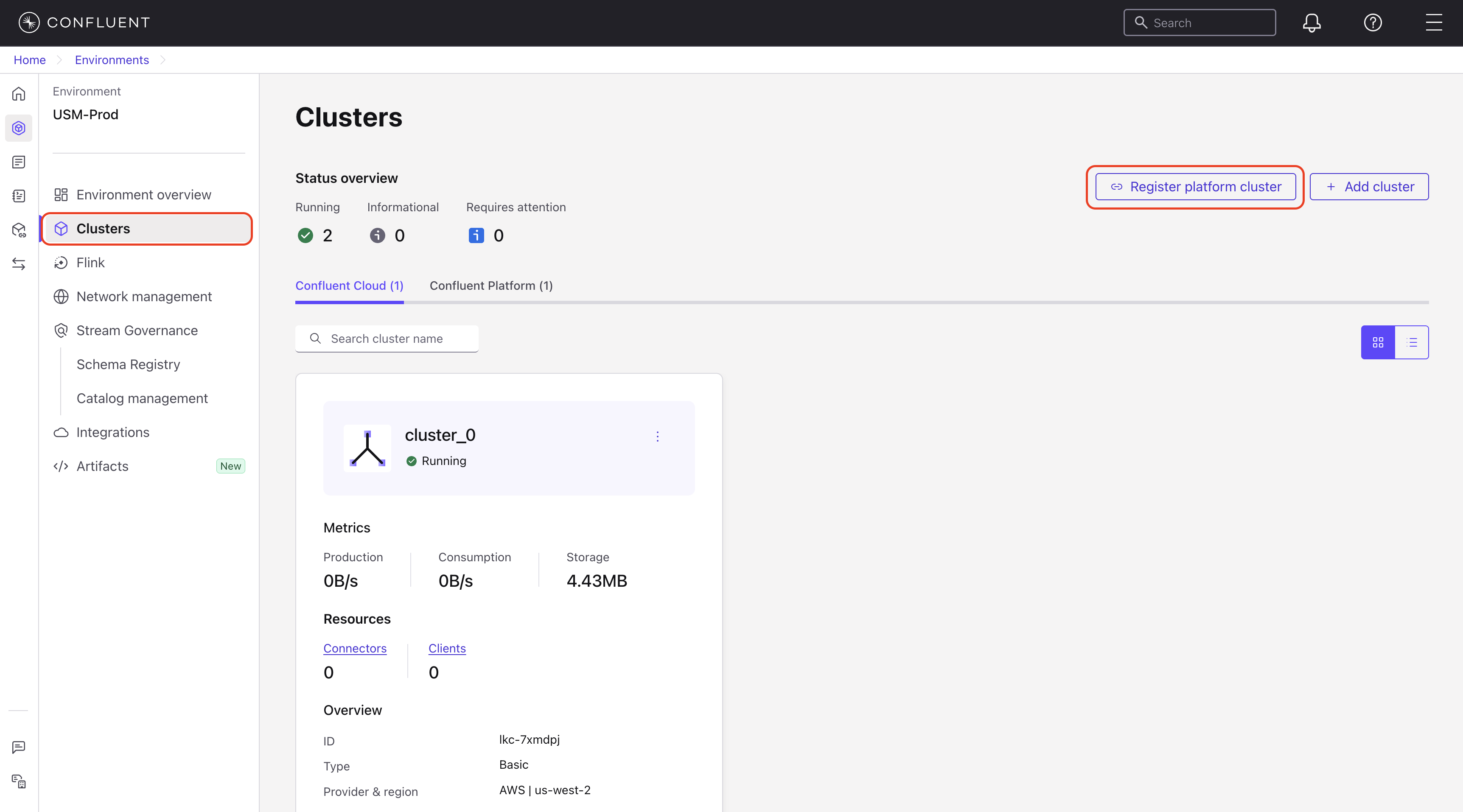
Choose New agent or Existing agent, then click Get started.
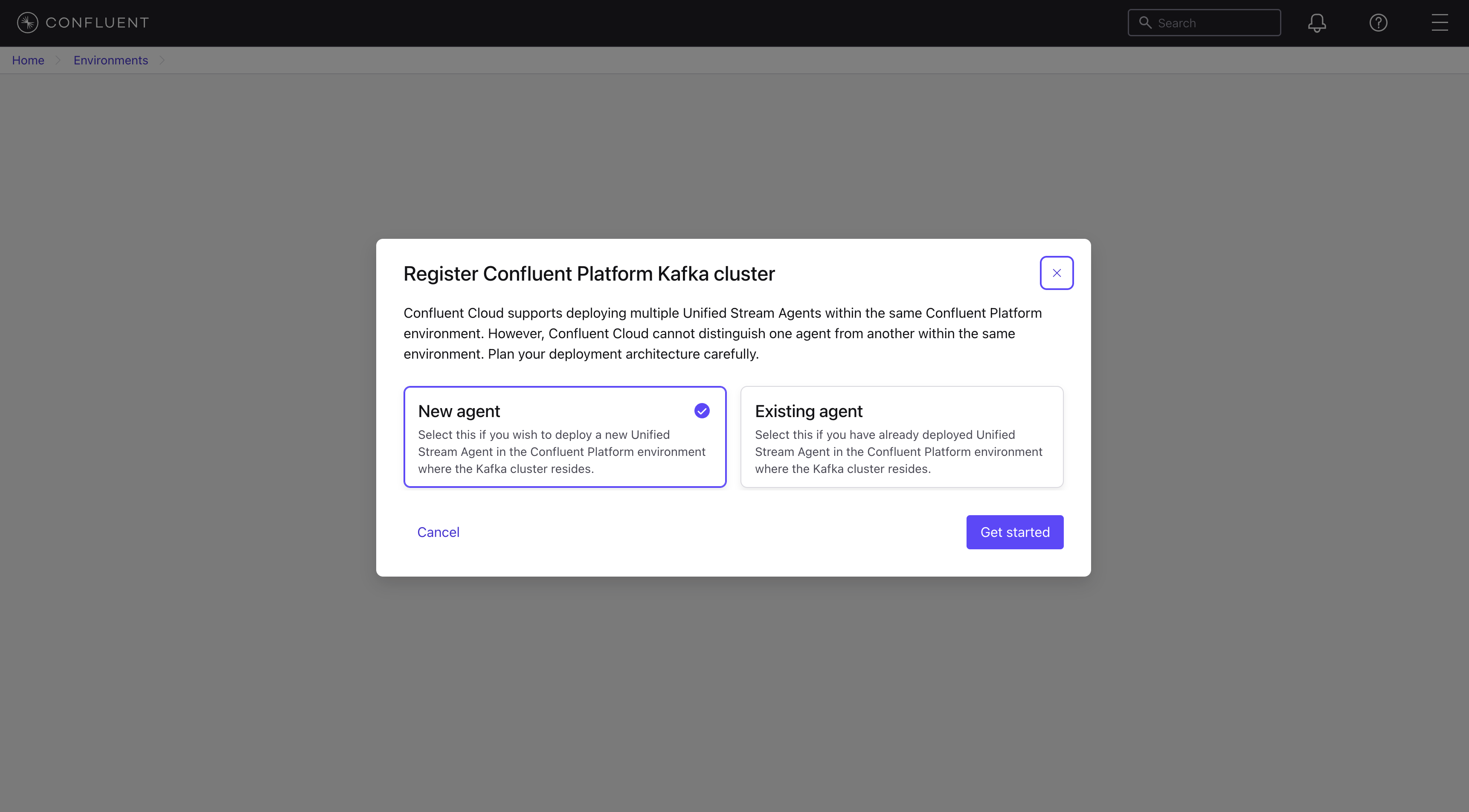
The registration dialog provides two options:
New agent: Deploy a new USM Agent in the Confluent Platform environment where the Kafka cluster resides to create a fresh agent deployment for the cluster.
Existing agent: Reuse an already deployed USM Agent in the Confluent Platform environment where the Kafka cluster resides to register additional clusters.
After you make your selection, click Get started to continue the registration process.
Deregister a Kafka cluster
When you deregister a Kafka cluster, the cluster is removed as a USM entity from Confluent Cloud. The USM Agent continues to run in your Confluent Platform environment and emits events, but Confluent Cloud rejects them because the Confluent Platform cluster no longer has a corresponding mapping in Confluent Cloud.
To stop these events, remove the USM-specific configuration from the Kafka cluster. After you remove the configuration, you can remove the USM Agent entirely, provided that no other Kafka or Connect cluster is using the agent.
You can deregister a Kafka cluster from USM using the Confluent Cloud Console or the Confluent CLI.
In the Confluent Cloud Console, you can deregister a Kafka cluster using one of the following methods:
From the Environments overview page
From the Clusters list
From the Cluster settings
In the Confluent Cloud Console, navigate to the Environments page and select your environment.
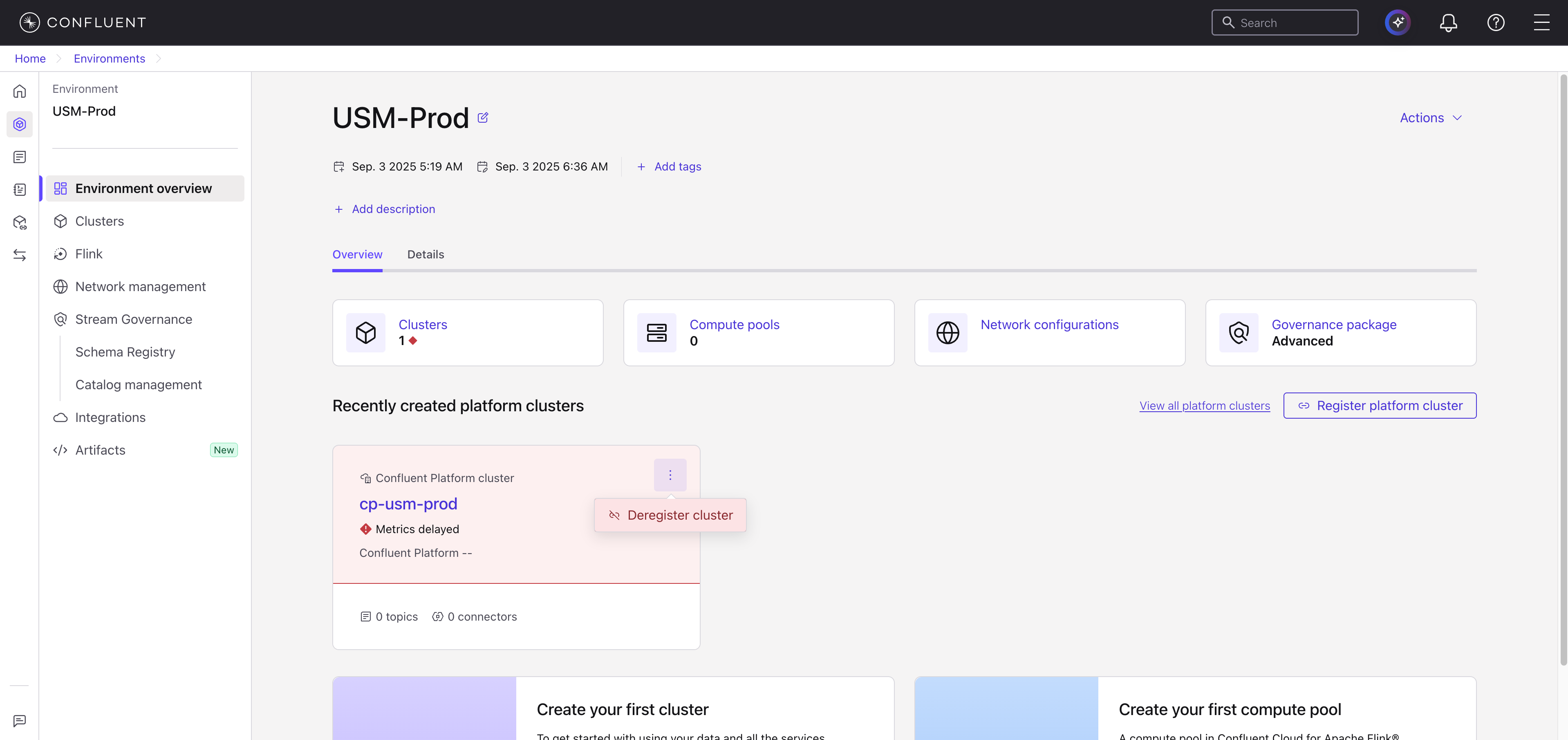
On the Environment overview page, locate the Recently created platform clusters section.
On the cluster card for the cluster you want to remove, click the More icon (three vertical dots).
Click Deregister cluster.
In the Deregistering Confluent Platform Kafka cluster dialog, enter the cluster name exactly as shown.
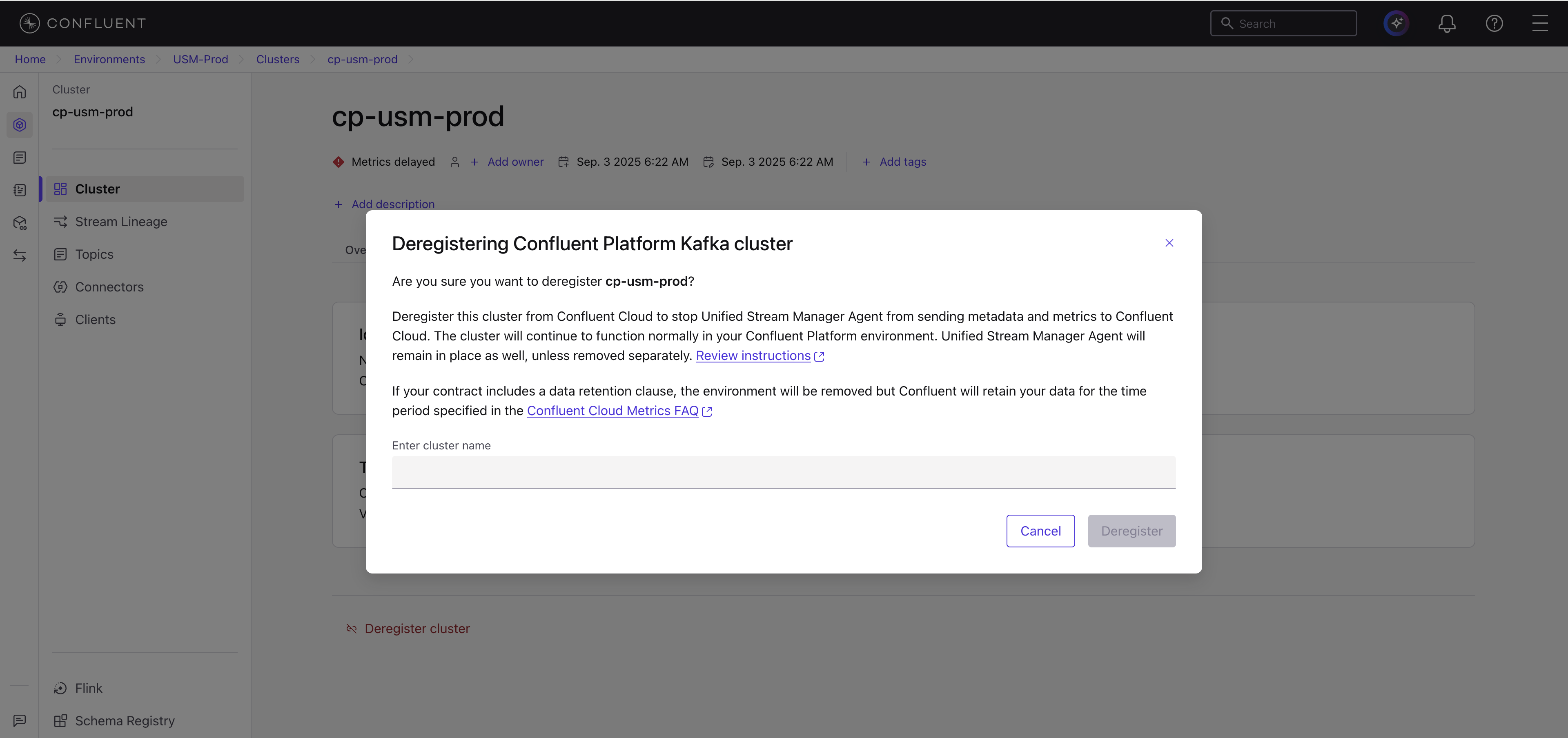
Click Deregister.
The cluster is removed from the Confluent Cloud Console.
In the Confluent Cloud Console, navigate to the Environments page and select your environment.
In the left navigation menu, click Clusters.
On the Clusters page, select the Confluent Platform tab.
Locate the cluster you want to deregister and click the More icon (three vertical dots).
Click Deregister cluster.
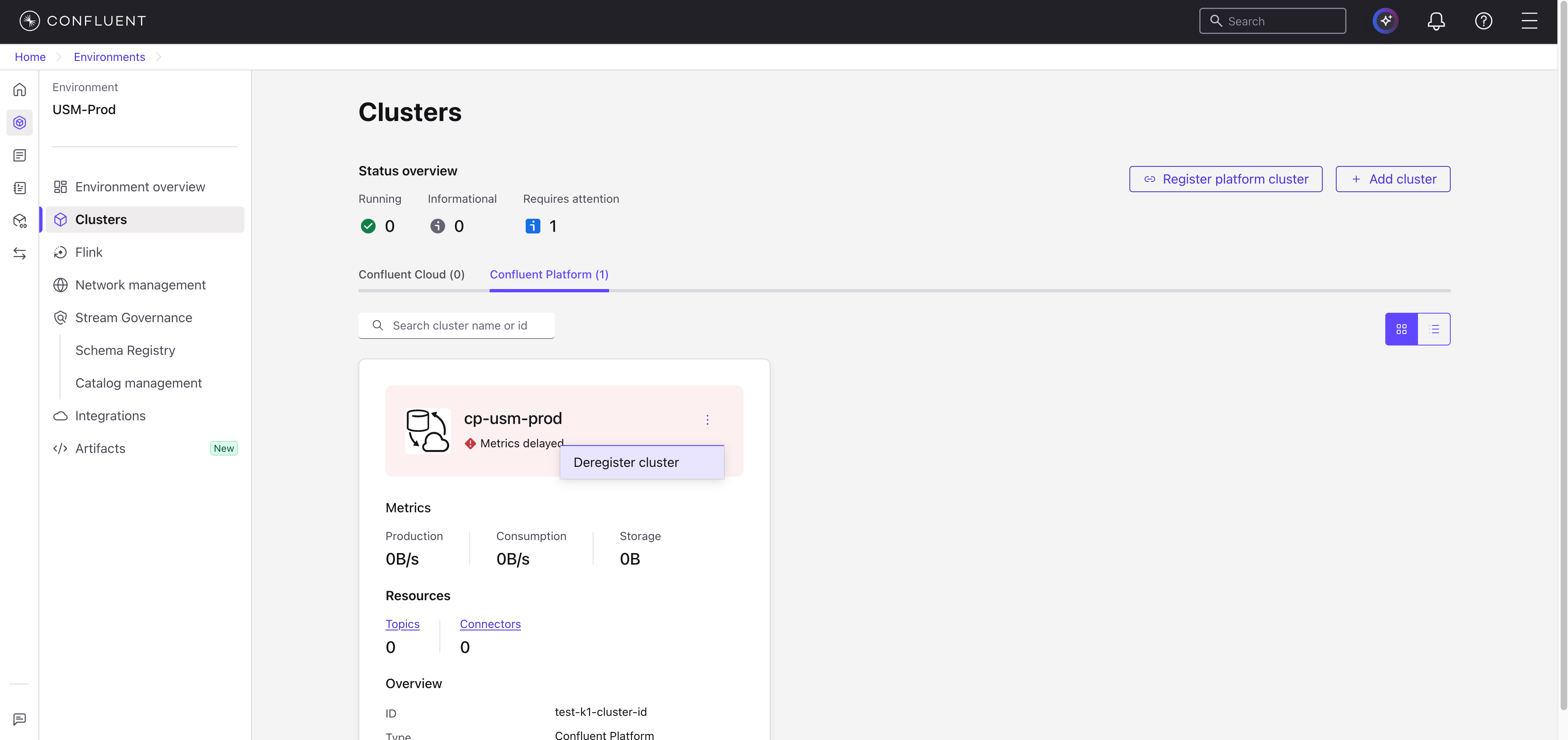
In the Deregistering Confluent Platform Kafka cluster dialog, enter the cluster name exactly as shown.
Click Deregister.
The cluster is removed from the Confluent Cloud Console.
In the Confluent Cloud Console, navigate to the Environments page and select your environment.
On the Clusters page, click the name of the cluster you want to deregister.
Click the Settings tab.
Click Deregister cluster at the bottom of the page.
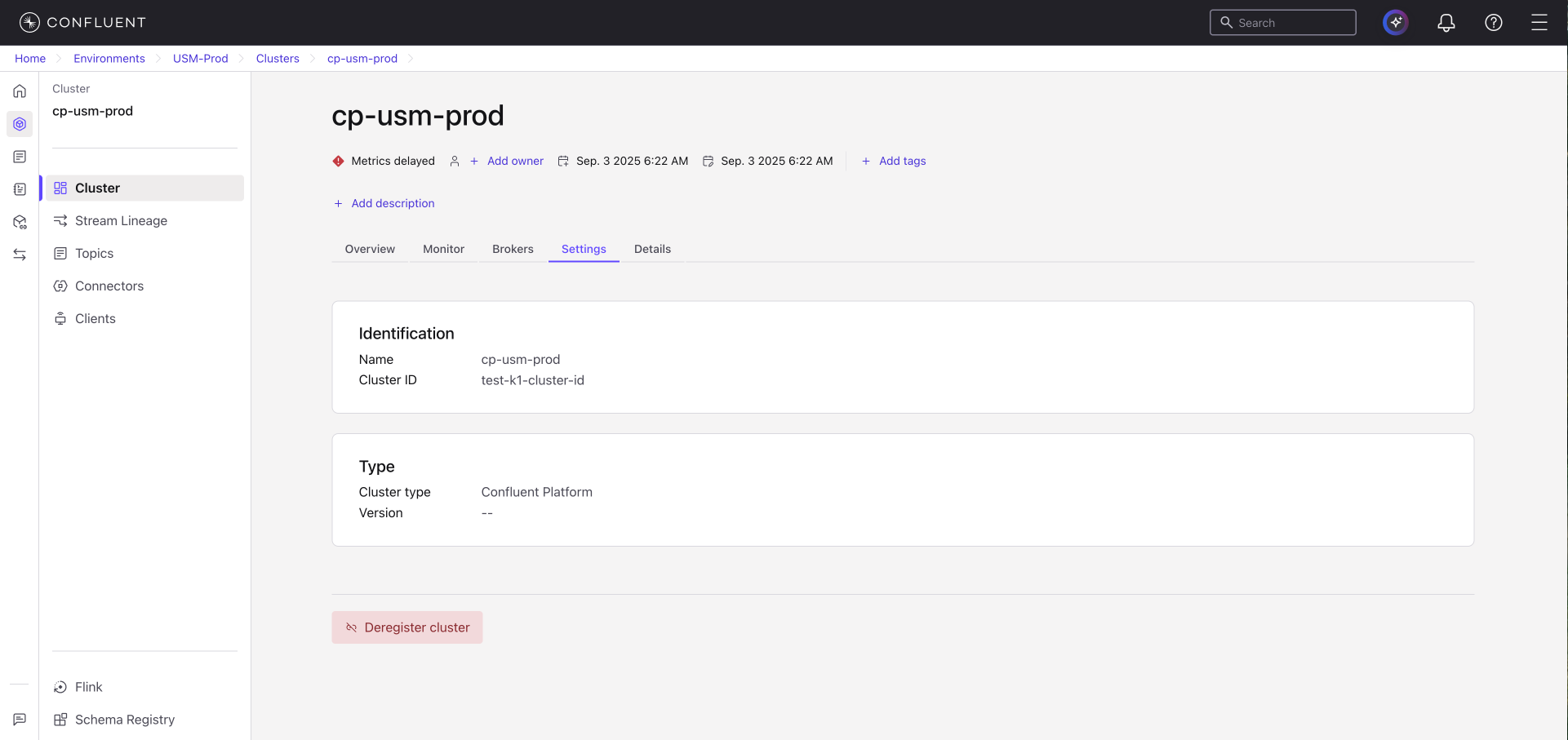
In the Deregistering Confluent Platform Kafka cluster dialog, enter the cluster name exactly as shown.
Click Deregister.
The cluster is removed from the Confluent Cloud Console.
Log in to the Confluent CLI.
confluent loginGet your environment ID. To find the environment ID:
In the Confluent Cloud Console, navigate to the Environments page and select your environment.
Click the Details tab and then copy the ID from the About section.
List the clusters in your environment to find the
USM_KAFKA_CLUSTER_IDof the cluster that you want to deregister:confluent usm kafka-cluster list --environment <YOUR_ENVIRONMENT_ID>
From the output, identify the cluster that you want to deregister and copy its ID. The
USM_KAFKA_CLUSTER_IDstarts with the prefixusmkc-.Deregister the cluster:
confluent usm kafka-cluster deregister <USM_KAFKA_CLUSTER_ID> --environment <YOUR_ENVIRONMENT_ID>
For example, to deregister a cluster with the ID
usmkc-abc123:confluent usm kafka-cluster deregister usmkc-abc123 --environment env-12345
When prompted, enter
yto confirm.Are you sure you want to deregister USM Kafka cluster "usmkc-abc123"? (y/n): y Deregistered USM Kafka cluster "usmkc-abc123".
The cluster is removed from the Confluent Cloud Console.
For more information about related commands, see the confluent usm CLI documentation.