

Enforce Data Governance Centrally with Confluent Gateway
Confluent Gateway enforces centralized governance for your Apache Kafka® workloads. You define data policies once in Confluent Schema Registry, and Confluent Gateway enforces them on every producer and consumer request.
Because enforcement happens in Confluent Gateway, only compliant records reach your Kafka clusters, and you can change rules across all routes without reconfiguring client applications or individual brokers. For more information about Schema Registry, see Schema Registry.
To use encryption rules, you need a CSFLE add-on license in addition to your Confluent Gateway add-on license. For more information, see Gateway Prerequisites. You can configure governance in Docker-based deployments and in Confluent for Kubernetes deployments. For CFK, see Enforce Centralized Governance for Confluent Gateway using Confluent for Kubernetes.
Centralized governance capabilities
Confluent Gateway applies the following governance capabilities to records that use Apache Avro®, JSON Schema, or Protobuf:
Schema ID enforcement: Ensures every record carries a valid Schema Registry schema ID for its topic.
Deep schema validation: Ensures every record’s payload conforms to its registered schema. For JSON Schema, Confluent Gateway enforces schema constraints, such as
minimumandenum, only if you setjson.fail.invalid.schemato"true". For more information, see Step 2: Enable governance for record keys and values.Field-level encryption: Encrypts and decrypts individual tagged fields in a record, as defined by data contract rules.
Full payload encryption: Encrypts and decrypts the entire record payload, as defined by data contract rules.
Data contract rules: Runs the other rules in a schema’s rule set, such as Common Expression Language (CEL) rules, when governance is enabled, the schema carries them, and
enableAtallows Confluent Gateway to run them.Independent key and value governance: Lets you enable or disable governance for record keys and record values separately.
Per-topic overrides: Lets you override the global settings on specific topics to support varying workload requirements.
How centralized governance enforcement works
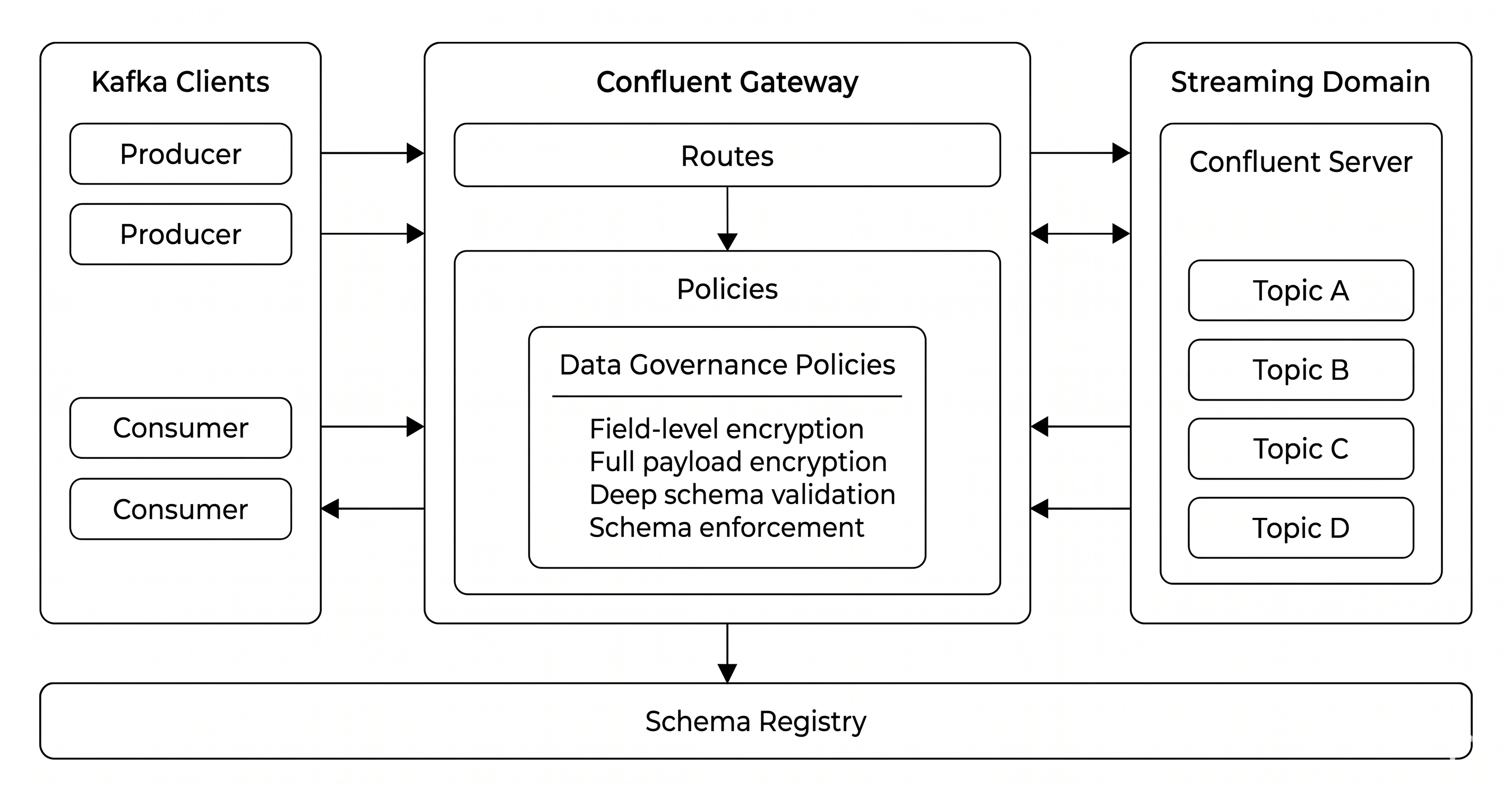
Confluent Gateway doesn’t store validation or encryption policies. It reads them from Schema Registry and enforces them. Governance involves these steps:
In Confluent Gateway, enable or disable governance for record keys and record values.
In Schema Registry, define the schema and its rule set. The schema and rules determine what Confluent Gateway enforces, and the
enableAtsetting in the rule set determines whether Confluent Gateway runs the rules.
Confluent Gateway runs the same checks on the produce path and the fetch path. It
evaluates each record key and value separately. For each one, it uses the
configured enabled setting and subject name strategy, and the schema
registered under the resulting subject.
The following table shows what Confluent Gateway enforces for a record key or value:
Confluent Gateway |
Schema |
Schema ID enforcement |
Deep schema validation |
Field-level encryption |
Full payload encryption |
|---|---|---|---|---|---|
|
Any |
No |
No |
No |
No |
|
|
Yes |
Yes |
No (run by the client or server) |
No (run by the client or server) |
|
|
Yes |
Yes |
Yes, if the schema has the rule |
Yes, if the schema has the rule |
Note the following:
When
enabledisfalse, Confluent Gateway forwards the key or value unchanged. It doesn’t read the schema ID and performs no enforcement, regardless of the schema’senableAtsetting.When
enabledistrue, Confluent Gateway always performs schema ID enforcement and deep schema validation, regardless of theenableAtsetting.When a record fails schema ID enforcement or deep schema validation, Confluent Gateway rejects the record on the produce path. On the fetch path, it fails the affected partition with an
UNKNOWN_SERVER_ERRORerror and returns no records for that partition.
Limitations
The following limitations apply to centralized governance enforcement:
Confluent Gateway doesn’t publish failed records to a dead letter queue (DLQ). It doesn’t support setting a rule’s
onFailurefield toDLQ. A rule withonFailure: DLQrejects the record. To route failed records to a DLQ topic, handle the error in your client application.You can’t enable schema ID enforcement and deep schema validation separately. Both run whenever you enable governance for a key or value, including when Confluent Gateway encrypts the same schema with
enableAt: GATEWAY.Records must carry a schema ID, either in the Schema Registry wire format or as a schema GUID in a record header. Confluent Gateway rejects records produced without one.
Confluent Gateway doesn’t enforce governance on null keys or null values, such as unkeyed records and tombstones.
If Confluent Gateway encrypts a topic’s records, it can’t decrypt records that were never encrypted, such as older records, records produced while governance was off, or records written directly to the cluster. When the encryption rule’s
onFailureaction for reads isERROR, Confluent Gateway fails the affected partition on fetch and doesn’t return records to the consumer.
Next steps
To configure Confluent Gateway to enforce centralized governance, verify enforcement, and handle errors, see Enforce Centralized Governance with Confluent Gateway.