

Configure Security for Confluent Cloud Gateway
Configure security for Confluent Cloud Gateway (Confluent Gateway) on Docker by setting up authentication, SSL, secret stores, and passwords.
For the security configuration steps using Confluent for Kubernetes (CFK), see Configure Security for Confluent Gateway using CFK.
Note
The swapConfig and passthroughConfig route settings are deprecated as
of Confluent Gateway 1.4.0. Existing configurations that use them keep working without changes.
The top-level layout for the Confluent Gateway security configuration is as follows:
gateway:
  secretStores:
  streamingDomains:
    kafkaCluster:
      bootstrapServers:
        - id:
          endpoint:
          ssl:
  routes:
    - name:
      security:
        auth:
        ssl:
        swapConfig:
        passthroughConfig:
For streamingDomains.kafkaCluster.bootstrapServers.ssl and
routes.security.ssl, see the SSL configuration section.
Security best practices and recommendations
Use unique Gateway-to-Broker credentials per client
Confluent Gateway deployments typically have two authentication layers:
Client → Confluent Gateway (SASL/PLAIN, SASL/SCRAM, SASL/OAUTHBEARER, mTLS, or NONE)
Confluent Gateway → Broker (SASL/PLAIN, SASL/OAUTHBEARER, or NONE), with secrets stored in AWS Secrets Manager, HashiCorp Vault, Azure Key Vault, CyberArk Conjur, or a local directory.
Apply these authentication best practices:
Choose SASL/SCRAM over SASL/PLAIN. Unlike SASL/PLAIN, SCRAM doesn’t send passwords in cleartext and protects against dictionary attacks using salted hashes.
Don’t map multiple client users to a single Confluent Gateway-to-Broker credential.
Each client should ideally have its own Confluent Gateway-to-Broker SASL credential.
Avoid static shared credentials across multiple clients.
Authentication configuration
Confluent Gateway supports two modes for authenticating clients and forwarding traffic to Kafka clusters: identity passthrough and authentication swapping.
Identity passthrough: Client credentials are forwarded directly to Kafka clusters without modification.
Use identity passthrough for environments where the authentication method is uniform and Confluent Gateway transparency is sufficient.
With identity passthrough, SASL authentication mechanisms, such as SASL/PLAIN, SASL/SCRAM, or SASL/OAUTHBEARER, are supported.
Authentication swapping: Client credentials are transformed into different credentials before connecting to Kafka clusters.
When enabled, Confluent Gateway authenticates incoming clients, optionally using a different authentication mechanism than the backing Kafka cluster. Confluent Gateway then swaps the client identity and credentials as it forwards requests to brokers.
- With authentication swapping,
SASL/PLAIN, SASL/SCRAM, SASL/OAUTHBEARER, mTLS, or NONE authentication is supported for client-to-Confluent Gateway authentication.
SASL/PLAIN, SASL/OAUTHBEARER, or NONE authentication is supported for Confluent Gateway-to-Kafka cluster authentication.
Use authentication swapping when you need to:
Migrate clients between source and destination clusters that have different authentication requirements, without modifying client applications.
Share cluster access with external clients while maintaining your internal authentication standards, even when you can’t enforce those standards directly on the client side.
The following diagram shows a sample authentication flow for authentication swapping:
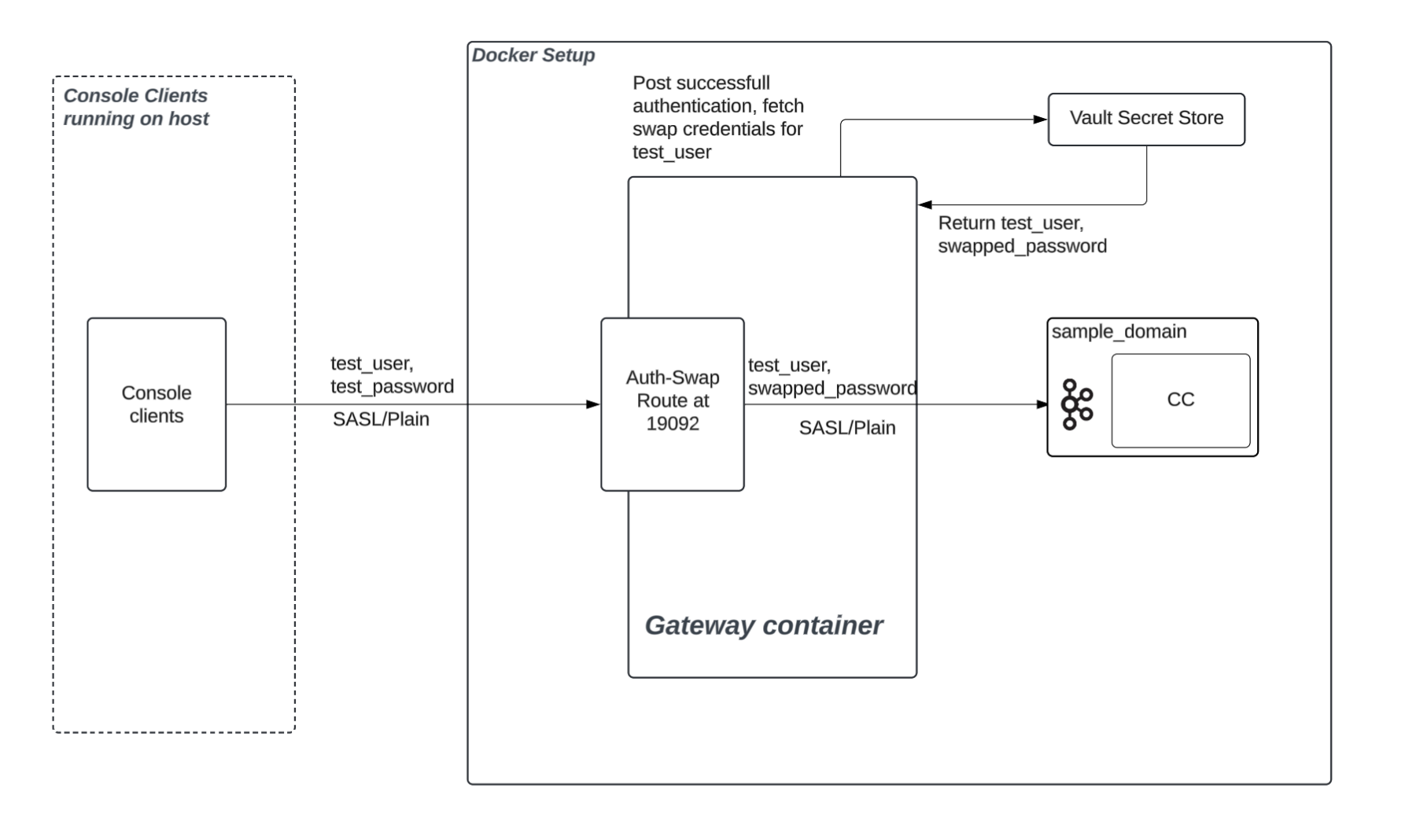
Some considerations when selecting the authentication mode in Confluent Gateway are:
You can configure either identity passthrough or authentication swapping for an individual route.
You cannot configure multiple authentication mechanisms for the same route while using authentication swapping.
Identity passthrough cannot be used for mTLS due to TLS termination at Confluent Gateway; currently, authentication swapping is mandatory for mTLS clients.
Swapping mandates more setup, such as identity stores, Key Management Systems (KMS), or mappings, but adds flexibility and supports more complex enterprise scenarios.
Authentication swapping with multi-cluster streaming domains requires identical user identities and role-based access control (RBAC) policies across all clusters. If clusters have different authentication systems or user permissions, use separate streaming domains instead.
Configure identity passthrough mode
Identity passthrough forwards client authentication information unchanged from Confluent Gateway to Kafka brokers. The brokers perform authentication and authorization checks.
Identity passthrough is supported for SASL authentication mechanisms, such as SASL/PLAIN, SASL/SCRAM, or SASL/OAUTHBEARER.
Use identity passthrough when client applications and Kafka clusters share the same authentication system, and you do not need to translate credentials at the gateway. Identity passthrough is not supported for mTLS clients because TLS terminates at Confluent Gateway. For mTLS, use authentication swapping instead.
Note
The passthroughConfig setting is deprecated as of 1.4.0. To configure
passthrough with the clientAuth and clusterAuth settings (Early
Access), see Route authentication configuration.
To migrate an existing route, see
Migrate from swapConfig and passthroughConfig.
To configure a route for identity passthrough in Docker Compose:
gateway:
  routes:
    - name:
      security:
        auth: passthrough              --- [1]
        passthroughConfig:             --- [2]
          sasl:
            mechanism:                 --- [3]
            extensionHeaders:          --- [4]
              logicalCluster:
[1] The authentication mode for the route. Set to
passthroughto enable identity passthrough.[2] Optional. Configures Confluent Gateway to inject SASL extension headers into the client’s authentication request before forwarding it to the backing Kafka cluster. Use
passthroughConfigwhen clients authenticate with SASL/OAUTHBEARER and the backing Kafka cluster requires a logical cluster (lkc) extension to identify the target cluster. Confluent Gateway sets the extension on the client’s behalf, which keeps client configurations independent of the active cluster, so authentication continues to succeed after a failover.[3] The client SASL mechanism that
passthroughConfigapplies to.OAUTHBEARERis the only supported value.[4] One or more SASL extension headers that Confluent Gateway adds to the client’s authentication request to the backing Kafka cluster. Each header is a key-value pair. Set
logicalClusterto the target cluster ID, for example,lkc-abc123.
Example: inject a logical cluster header for SASL/OAUTHBEARER passthrough:
gateway:
  routes:
    - name:
      security:
        auth: passthrough
        passthroughConfig:
          sasl:
            mechanism: OAUTHBEARER
            extensionHeaders:
              logicalCluster: 'lkc-abc123'
Configure authentication swapping mode
When a route is configured for authentication swapping, Confluent Gateway authenticates incoming clients, optionally using a different authentication mechanism than the backing Kafka cluster. Confluent Gateway then swaps the client identity and credentials as it forwards requests to Kafka brokers.
Authentication swapping requires configuration of identity mapping, potentially integration with external KMS or secret stores, and audit policies.
The following secret stores are supported for fetching credentials:
HashiCorp Vault
AWS Secrets Manager
Azure Key Vault
CyberArk Conjur
File
Note
The swapConfig setting is deprecated as of 1.4.0. To configure
authentication swapping with the clientAuth and clusterAuth
settings (Early Access), see Route authentication configuration.
To migrate an existing route, see
Migrate from swapConfig and passthroughConfig.
To configure a route for authentication swapping in Docker Compose:
gateway:
  routes:
    - name:               --- [1]
      security:
        auth: swap        --- [2]
        swapConfig:
          clientAuth:     --- [3]
          secretStore:    --- [4]
          clusterAuth:    --- [5]
[1] The unique name for the route.
[2] The authentication mode for the route. Set to
swapto enable authentication swapping.[3] How clients authenticate to Confluent Gateway. See Client authentication for authentication swapping.
[4] Reference to a secret store for exchanging credentials. See Secret store configuration.
[5] How Confluent Gateway authenticates to the Kafka cluster after swapping. See Cluster authentication for authentication swapping.
Client authentication for authentication swapping
Define how clients authenticate to the Confluent Gateway. Enable exactly one authentication provider:
SASL
mTLS
None
SASL/PLAIN authentication
gateway:
  routes:
    - name:
      security:
        auth: swap
        swapConfig:
          clientAuth:
            sasl:
              mechanism:               --- [1]
              callbackHandlerClass:    --- [2]
              jaasConfig:
                file:                  --- [3]
            connectionsMaxReAuthMs:    --- [4]
[1] The SASL mechanism to use. Set to
PLAINfor SASL/PLAIN authentication.[2] The callback handler class to use. Set to
org.apache.kafka.common.security.plain.internals.PlainServerCallbackHandlerfor SASL/PLAIN authentication.[3] The path to the Java Authentication and Authorization Service (JAAS) configuration file. See the JAAS configuration file content for SASL/PLAIN authentication later in this section.
[4] The maximum re-authentication time in milliseconds.
JAAS configuration file content for SASL/PLAIN authentication
org.apache.kafka.common.security.plain.PlainLoginModule required
    username="admin"
    password="admin-secret"
    user_admin="admin-secret";
The JAAS configuration file content is a single login-module entry, ending in
;, with the following properties:
org.apache.kafka.common.security.plain.PlainLoginModule: The login module to use.username: The username to use.password: The password to use.user_<username>: Defines the password for each user that connects to Confluent Gateway. Add oneuser_<username>property per user.
A sample JAAS configuration file content:
org.apache.kafka.common.security.plain.PlainLoginModule required
    username="admin"
    password="admin-secret"
    user_admin="admin-secret"
    user_additional-user="additionaluser-secret";
SASL/SCRAM authentication
Confluent Gateway supports SASL/SCRAM authentication for client-to-Confluent Gateway connections. When using SCRAM with authentication swapping, you have three options for managing SCRAM credentials:
Store SCRAM credentials in the same secret store as authentication swapping: SCRAM credentials are stored in the route’s secret store.
Store SCRAM credentials in a SCRAM-specific secret store: SCRAM credentials are stored in a separate secret store from other authentication swap credentials.
Manage SCRAM credentials through Gateway: Confluent Gateway creates, updates, and deletes SCRAM user credentials in the secret store when the administrator user sends
AlterUserScramCredentialsrequests to Confluent Gateway.
SCRAM doesn’t store a plain password. It stores derived cryptographic material, a salted hash, which can only be represented as structured JSON, not a plain string.
Note
Regardless of the useJson setting on the secret store, Confluent Gateway
always requires SCRAM credentials to be stored as JSON. useJson
only affects how the secret store provider returns raw, non-SCRAM
secret values, such as PLAIN username and password credentials.
gateway:
  routes:
    - name:
      security:
        auth: swap
        swapConfig:
          secretStore: vault-store   --- [1]
          clientAuth:
            sasl:
              mechanism: SCRAM   --- [2]
              scram:
                alterScramCredentials: true   --- [3]
                scramCredentialsTtlMs: 600000   --- [4]
                secretStore: scram-vault-store --- [5]
                admin:                          --- [6]
                  username: admin-user
                  password: admin-password
[1] The secret store reference for authentication swapping. For more information, see Secret store configuration.
[2] The SASL mechanism to use for client authentication. Set to
SCRAMfor SASL/SCRAM authentication.[3] Optional. When set to
true, Confluent Gateway handles theAlterUserScramCredentialsandDescribeUserScramCredentialsrequests that the administrator user sends, and stores the credentials in the secret store. Confluent Gateway doesn’t forward these requests to the Kafka cluster. This field requires administrator credentials. The default isfalse.[4] Optional. The time-to-live, in milliseconds, for cached SCRAM credentials. The default is
600000(10 minutes).[5] Optional. A SCRAM-specific secret store. If not specified, the field uses the secret store defined in
swapConfig.secretStore.[6] Required when
alterScramCredentials: true. The administratorusernameandpassword. Only this user can send SCRAM credential requests to Confluent Gateway, and the user authenticates to Confluent Gateway with these credentials.
Configuration scenario 1: Using the same secret store as authentication swapping
In this configuration, you store SCRAM credentials in the route’s secret store.
gateway:
  routes:
    - name: gateway-route
      security:
        auth: swap
        swapConfig:
          secretStore: vault-store
          clientAuth:
            sasl:
              mechanism: SCRAM
Configuration scenario 2: Using a SCRAM-specific secret store
In this configuration, you store SCRAM credentials in a separate secret store from other authentication swap credentials.
gateway:
  routes:
    - name: gateway-route
      security:
        auth: swap
        swapConfig:
          secretStore: vault-store
          clientAuth:
            sasl:
              mechanism: SCRAM
              scram:
                secretStore: scram-secret-store
Configuration scenario 3: Managing SCRAM credentials from Gateway
In this configuration, Confluent Gateway creates, updates, and deletes SCRAM user
credentials in the secret store when the administrator user sends
AlterUserScramCredentials requests to Confluent Gateway. Complete the following:
Provide
admin.usernameandadmin.password.Send the
AlterUserScramCredentialsandDescribeUserScramCredentialsrequests to Confluent Gateway as the administrator user. Confluent Gateway doesn’t forward these requests to the Kafka cluster and doesn’t check Kafka access control lists (ACLs).
gateway:
  routes:
    - name: gateway-route
      security:
        auth: swap
        swapConfig:
          secretStore: vault-store
          clientAuth:
            sasl:
              mechanism: SCRAM
              scram:
                alterScramCredentials: true
                admin:
                  username: admin-user
                  password: admin-password
Note
When using alterScramCredentials: true, ensure that Confluent Gateway
has the necessary permissions to create, update, and delete
secrets.
For required permissions, see Secret store configuration.
Expected JSON format for a SCRAM secret
When you provision SCRAM credentials manually (alterScramCredentials:
false), store each credential in the secret store under the name
SCRAM_<username>, with the following JSON structure. If the secret
store has a prefixPath configured, Confluent Gateway looks up the secret under
<prefixPath>SCRAM_<username>, the same way prefixPath applies to
other credential lookups on this page.
{
    "sha256": {
        "salt": "<base64-encoded-salt>",
        "storedKey": "<base64-encoded-storedKey>",
        "serverKey": "<base64-encoded-serverKey>",
        "iterations": 4096
    },
    "sha512": {
        "salt": "<base64-encoded-salt>",
        "storedKey": "<base64-encoded-storedKey>",
        "serverKey": "<base64-encoded-serverKey>",
        "iterations": 4096
    }
}
At least one
sha256orsha512must be present. Include the block or blocks that correspond to the SCRAM mechanisms your clients use.If a block is present, it must include all four fields:
salt,storedKey,serverKey, anditerations.salt,storedKey, andserverKeymust be standard Base64-encoded strings of the raw binary output from the SCRAM key-derivation steps defined in Request for Comments (RFC) 5802, the same algorithm Kafka uses internally. The derivation uses two intermediate values,SaltedPasswordandClientKey, that aren’t stored in the JSON secret themselves:salt: Random bytes. 16 bytes is typical. Not derived from the password.SaltedPassword:PBKDF2WithHmacSHA256for thesha256block, orPBKDF2WithHmacSHA512for thesha512block, applied to the password, salt, and iteration count.ClientKey:HMAC(SaltedPassword, "Client Key").storedKey: Hash ofClientKey, using SHA-256 or SHA-512 to match the block.serverKey:HMAC(SaltedPassword, "Server Key").
Base64-encode the raw
salt,storedKey, andserverKeybytes computed in the preceding steps for the corresponding JSON values.iterationsmust be between4096and16384.
SCRAM configuration limitations
The following limitations apply when configuring SCRAM authentication:
No standalone tool exists for generating SCRAM credential material. The
salt,storedKey, andserverKeyvalues are cryptographic hashes derived from the password, so you can’t create them by hand. If you don’t enablealterScramCredentials: true, follow the RFC 5802 key derivation steps described previously, or use an existing library that implements them, to compute and provision the JSON secret yourself, as described in Expected JSON format for a SCRAM secret.SCRAM secrets must always be stored as JSON, regardless of the
useJsonsetting on the secret store.The
clusterAuthblock, used for Confluent Gateway-to-Kafka cluster authentication, doesn’t support SCRAM. See Cluster authentication for authentication swapping.Azure Key Vault doesn’t support SCRAM credential storage. See Secret store configuration.
SASL/OAUTHBEARER authentication (OAuth-to-OAuth support)
Confluent Gateway supports SASL/OAUTHBEARER authentication for client-to-Confluent Gateway connections, including OAuth-to-OAuth support, where the client authenticates to Confluent Gateway with an OAuth token and Confluent Gateway separately authenticates to the backing Kafka cluster with its own OAuth token. The client presents an OAuth bearer token, and Confluent Gateway validates its signature against your identity provider’s JSON Web Key Set (JWKS) endpoint.
After validation, Confluent Gateway reads the client principal from a claim in the token and uses it as the lookup key for the swapped credentials in the secret store.
gateway:
  routes:
    - name:
      security:
        auth: swap
        swapConfig:
          clientAuth:
            sasl:
              mechanism: OAUTHBEARER             --- [1]
              callbackHandlerClass: "org.apache.kafka.common.security.oauthbearer.OAuthBearerValidatorCallbackHandler"  --- [2]
              jaasConfig:
                file:                            --- [3]
              oauth:
                jwksEndpointUrl:                 --- [4]
                jwksEndpointRefreshMs:           --- [5]
                jwksEndpointRetryBackoffMs:      --- [6]
                jwksEndpointRetryBackoffMaxMs:   --- [7]
                expectedAudience:                --- [8]
                expectedIssuer:                  --- [9]
                subClaimName:                    --- [10]
                scopeClaimName:                  --- [11]
            connectionsMaxReAuthMs:              --- [12]
[1] The SASL mechanism to use. Set to
OAUTHBEARERfor SASL/OAUTHBEARER authentication.[2] The callback handler class to use. Set to
org.apache.kafka.common.security.oauthbearer.OAuthBearerValidatorCallbackHandler, as Confluent Gateway validates client tokens as a SASL server.[3] The path to the JAAS configuration file that Confluent Gateway loads to set up token validation. Because Confluent Gateway only validates the inbound token, the file doesn’t need to define login options:
org.apache.kafka.common.security.oauthbearer.OAuthBearerLoginModule required;
[4] Required. The JWKS endpoint URL that Confluent Gateway uses to validate the signature of the inbound token. For example:
jwksEndpointUrl: "https://idp.mycompany.io:8080/realms/clients/protocol/openid-connect/certs"
[5] Optional. The interval, in milliseconds, at which Confluent Gateway refreshes its JWKS cache. The default is
3600000(1 hour).[6] Optional. The delay, in milliseconds, that Confluent Gateway waits before the first retry after a failed JWKS retrieval. Each subsequent retry increases this delay exponentially, up to the maximum set by
jwksEndpointRetryBackoffMaxMs. The default is100.[7] Optional. The maximum delay, in milliseconds, between JWKS retrieval retries. This sets the upper limit for the exponential increase set by
jwksEndpointRetryBackoffMs. The default is10000.[8] Optional. The expected audience (the
audclaim) in the token. Your identity provider sets this claim to identify who it issued the token for. Provide a comma-separated list to accept multiple audiences. Confluent Gateway rejects tokens whoseaudclaim doesn’t match one of the listed values.[9] Optional. The expected issuer (the
issclaim) in the token. Your identity provider sets this claim to identify itself as the token’s issuer. Confluent Gateway rejects tokens whoseissclaim doesn’t match this value.[10] Optional. The token claim that Confluent Gateway reads to determine the client’s identity (the principal). Confluent Gateway uses this value as the key to look up the client’s swapped credentials in the secret store. Most identity providers populate the standard OAuth/OpenID Connect (OIDC)
sub(subject) claim with a unique client identifier, so the default issub. Override this only if your identity provider uses a different claim to identify the client.[11] Optional. The token claim that Confluent Gateway reads to determine the client’s granted scope (the level of access the identity provider authorized for this token). Most identity providers populate the standard OAuth
scopeclaim, so the default isscope. Override this only if your identity provider uses a different claim name.[12] Optional. The maximum re-authentication time in milliseconds.
mTLS authentication
gateway:
  routes:
    - name:
      security:
        auth: swap
        swapConfig:
          clientAuth:
            ssl:
              principalMappingRules: --- [1]
[1] Required only for authentication swapping with mTLS authentication. The pattern to read principal name from the certificates. For example:
"RULE:^CN=([a-zA-Z0-9._-]+),OU=.*$/$1/,RULE:^UID=([a-zA-Z0-9._-]+),.*$/$1/,DEFAULT"
NONE authentication
gateway:
  routes:
    - name:
      security:
        auth: swap
        swapConfig:
          clientAuth:
            none: {}
When using none authentication, Confluent Gateway identifies all incoming
clients as anonymous and assigns the client ID ANONYMOUS. Configure
the swapped credentials for the ANONYMOUS user in the associated
secret store.
Cluster authentication for authentication swapping
Cluster authentication defines how Confluent Gateway authenticates to the Kafka cluster after swapping credentials. SASL and NONE are supported.
SASL authentication
gateway:
  routes:
    - name:
      security:
        auth: swap
        swapConfig:
          clusterAuth:
            sasl:
              mechanism:               --- [1]
              callbackHandlerClass:    --- [2]
              jaasConfig:
                file:                  --- [3]
              oauth:
                tokenEndpointUri:      --- [4]
[1] The SASL mechanism to use. Set to
PLAINfor SASL/PLAIN authentication orOAUTHBEARERfor SASL/OAUTHBEARER authentication. Confluent Gateway doesn’t supportSCRAMfor cluster authentication.[2] The callback handler class to use. Set to
org.apache.kafka.common.security.authenticator.SaslClientCallbackHandlerfor SASL/PLAIN authentication, ororg.apache.kafka.common.security.oauthbearer.OAuthBearerLoginCallbackHandlerfor SASL/OAUTHBEARER authentication. Confluent Gateway acts as a client when authenticating to brokers, so use the client-side callback handler.[3] The path to the JAAS configuration file.
[4] The URI for the OAuth token endpoint.
JAAS configuration file content for SASL/PLAIN authentication
org.apache.kafka.common.security.plain.PlainLoginModule required username="%s" password="%s";
JAAS configuration file content for SASL/OAUTHBEARER authentication
org.apache.kafka.common.security.oauthbearer.OAuthBearerLoginModule required clientId="%s" clientSecret="%s";
NONE authentication
The none authentication method disables authentication between Confluent Gateway
and the cluster. In this mode, Confluent Gateway ignores the client ID and bypasses
cluster authentication.
Because Confluent Gateway doesn’t require a secret lookup, skip the secret store configuration. Including a secret store in this configuration triggers a validation error.
gateway:
  routes:
    - name:
      security:
        auth: swap
        swapConfig:
          clusterAuth:
            none: {}
Authentication swapping examples
SASL/PLAIN to SASL/OAUTHBEARER example:
gateway:
  routes:
    - name: gateway
      security:
        auth: swap
        ssl:
          ignoreTrust: false
          truststore:
            type: PKCS12
            location: /opt/ssl/client-truststore.p12
            password:
              file: /opt/secrets/client-truststore.password
          keystore:
            type: PKCS12
            location: /opt/ssl/gw-keystore.p12
            password:
              file: /opt/secrets/gw-keystore.password
            keyPassword:
              value: inline-password
          clientAuth: none

        swapConfig:
          clientAuth:
            sasl:
              mechanism: PLAIN
              callbackHandlerClass: "org.apache.kafka.common.security.plain.internals.PlainServerCallbackHandler" # required for PLAIN
              jaasConfig: # required for PLAIN
                  file: /opt/gateway/gw-users.conf
            connectionsMaxReAuthMs: 0 # optional. link: https://docs.confluent.io/platform/current/installation/configuration/broker-configs.html#connections-max-reauth-ms
          secretStore: s1
          clusterAuth:
            sasl:
              mechanism: OAUTHBEARER
              callbackHandlerClass: "org.apache.kafka.common.security.oauthbearer.OAuthBearerLoginCallbackHandler"
              jaasConfig:
                file: /opt/gateway/cluster-login.tmpl.conf
              oauth: # required when mechanism is OAUTHBEARER
                tokenEndpointUri: "https://idp.mycompany.io:8080/realms/cp/protocol/openid-connect/token"
mTLS to SASL/OAUTHBEARER example:
gateway:
  routes:
    - name: gateway
      security:
        auth: swap
        ssl:
          ignoreTrust: false
          truststore:
            type: PKCS12
            location: /opt/ssl/client-truststore.p12
            password:
              file: /opt/secrets/client-truststore.password
          keystore:
            type: PKCS12
            location: /opt/ssl/gw-keystore.p12
            password:
              file: /opt/secrets/gw-keystore.password
            keyPassword:
              value: inline-password
          clientAuth: required
        swapConfig:
          clientAuth:
            ssl:
              principalMappingRules: "RULE:^CN=([a-zA-Z0-9._-]+),OU=.*$/$1/,RULE:^UID=([a-zA-Z0-9._-]+),.*$/$1/,DEFAULT"
          secretStore: "oauth-secrets"
          clusterAuth:
            sasl:
              mechanism: OAUTHBEARER
              callbackHandlerClass: "org.apache.kafka.common.security.oauthbearer.OAuthBearerLoginCallbackHandler"
              jaasConfig:
                file: "/etc/gateway/cluster-jaas.tmpl.conf"
              oauth:
                tokenEndpointUri: "https://idp.mycompany.io:8080/realms/cp/protocol/openid-connect/token"
Note
When using SASL/OAUTHBEARER as the cluster authentication mechanism,
you must also allowlist the OAuth token endpoint URL by passing a JVM
argument through the GATEWAY_OPTS environment variable in your
docker-compose.yaml:
gateway:
  environment:
    GATEWAY_OPTS: "-Dorg.apache.kafka.sasl.oauthbearer.allowed.urls=<tokenEndpointUri>"
Replace <tokenEndpointUri> with the same URL set in oauth.tokenEndpointUri.
If clients also authenticate with SASL/OAUTHBEARER, add the
oauth.jwksEndpointUrl value to the same comma-separated list.
Without this, Confluent Gateway rejects requests to the OAuth endpoint with an
is not allowed error. For more information, see OAuth token or JWKS endpoint not allowed.
SASL/OAUTHBEARER to SASL/OAUTHBEARER (OAuth-to-OAuth) example:
In this configuration, the client presents an OAuth token to Confluent Gateway. Confluent Gateway validates the token against the client identity provider’s JWKS endpoint, then obtains a separate token from the cluster identity provider to authenticate to the Kafka cluster.
gateway:
  routes:
    - name: gateway
      security:
        auth: swap
        swapConfig:
          clientAuth:
            sasl:
              mechanism: OAUTHBEARER
              callbackHandlerClass: "org.apache.kafka.common.security.oauthbearer.OAuthBearerValidatorCallbackHandler"
              jaasConfig:
                file: "/opt/gateway/client-oauth-jaas.conf"
              oauth:
                jwksEndpointUrl: "https://idp.mycompany.io:8080/realms/clients/protocol/openid-connect/certs"
                expectedAudience: "kafka-clients"
                expectedIssuer: "https://idp.mycompany.io:8080/realms/clients"
                subClaimName: "sub"
          secretStore: "oauth-secrets"
          clusterAuth:
            sasl:
              mechanism: OAUTHBEARER
              callbackHandlerClass: "org.apache.kafka.common.security.oauthbearer.OAuthBearerLoginCallbackHandler"
              jaasConfig:
                file: "/opt/gateway/cluster-oauth-jaas.conf"
              oauth:
                tokenEndpointUri: "https://idp.mycompany.io:8080/realms/cp/protocol/openid-connect/token"
Note
Confluent Gateway requires the endpoint for each OAuth leg to be allowlisted.
In this example, both the client and cluster legs use OAuth, so set
GATEWAY_OPTS to a comma-separated list that includes both the
client JWKS endpoint and the cluster token endpoint:
gateway:
  environment:
    GATEWAY_OPTS: "-Dorg.apache.kafka.sasl.oauthbearer.allowed.urls=https://idp.mycompany.io:8080/realms/clients/protocol/openid-connect/certs,https://idp.mycompany.io:8080/realms/cp/protocol/openid-connect/token"
Otherwise, Confluent Gateway rejects requests to either OAuth endpoint with an
is not allowed error. For more information, see
OAuth token or JWKS endpoint not allowed.
Route authentication configuration
Use the security.clientAuth and security.clusterAuth settings to
configure authentication on a route, including a dynamic route that uses
topic-based routing. Configure
clientAuth once to set how clients authenticate to Confluent Gateway. Configure
clusterAuth for each streaming domain that the route is bound to, to set
how Confluent Gateway authenticates to that streaming domain.
These settings replace swapConfig and passthroughConfig, which are
deprecated as of 1.4.0. You can’t combine them on the same route. To migrate an
existing route, see Migrate from swapConfig and passthroughConfig.
Note
Route authentication is an Early Access feature and is part of topic-based routing. Property names and YAML structure might change before General Availability (GA), and the changes might not be backward compatible.
gateway:
  routes:
    - name: migration
      security:
        clientAuth:                     --- [1]
          sasl:
            mechanism: PLAIN            --- [2]
            callbackHandlerClass: org.apache.kafka.common.security.plain.internals.PlainServerCallbackHandler
            jaasConfig:
              file: /etc/gateway/client-plain-jaas.conf
        clusterAuth:                    --- [3]
          cp:                          --- [4]
            auth: passthrough           --- [5]
          cc:
            auth: swap
            secretStore: kms-store      --- [6]
            sasl:                       --- [7]
              mechanism: PLAIN
              callbackHandlerClass: org.apache.kafka.common.security.authenticator.SaslClientCallbackHandler
              jaasConfig:
                file: /etc/gateway/cc-swap-jaas.conf
[1] How clients authenticate to Confluent Gateway. All clients of the route use the same method, regardless of the streaming domain they read from or write to. Required if any
clusterAuthentry usesauth: swap. Set exactly one of the following authentication methods:sasl: Clients authenticate with Simple Authentication and Security Layer (SASL) ([2]).ssl: Clients authenticate with mTLS.none: Clients connect anonymously.
For the
saslandsslsettings, see Client authentication for authentication swapping.[2] The SASL mechanism that clients use:
PLAIN,OAUTHBEARER, or aSCRAMmechanism. Each mechanism has the following requirements:PLAIN: RequirescallbackHandlerClassandjaasConfig.OAUTHBEARER: RequirescallbackHandlerClass. Also requiresoauthandjaasConfigwhen anyclusterAuthentry usesauth: swap.SCRAM: Confluent Gateway takes the credentials from the secret store that you set inscram.secretStore. Don’t setcallbackHandlerClass,jaasConfig, oroauth.
[3] How Confluent Gateway authenticates to each streaming domain that the route is bound to. Add one entry for each streaming domain, using the streaming domain name as the entry name. If a bound streaming domain has no entry, Confluent Gateway uses
passthroughfor it. If no entry usesauth: swap, Confluent Gateway ignoresclientAuth.[4] The name of a streaming domain that the route is bound to. Each name must match
gateway.streamingDomains[].name.[5] The authentication strategy for the streaming domain:
passthrough(default) orswap.passthrough: Confluent Gateway relays the client’s SASL exchange to the streaming domain. Apassthroughentry can’t setsecretStoreornone, and if it setssasl.mechanism, the mechanism must beOAUTHBEARER. Apassthroughentry can also setsasl.extensionHeadersto add SASL extension headers, such aslogicalCluster, to the client’s authentication request.swap: Confluent Gateway replaces the client’s credentials with its own when it connects to the streaming domain. Set exactly one of the following settings:sasl([7]): Confluent Gateway authenticates with SASL. RequiressecretStore([6]).none: Confluent Gateway connects without authenticating. Don’t setsecretStore.
[6] The name of the secret store that holds the credentials that Confluent Gateway uses to authenticate to the streaming domain. Must match a
gateway.secretStores[].name. For more information, see Secret store configuration.Required if
authisswapand you setsasl.Not allowed if
authispassthrough, or ifauthisswapand you setnone.
[7] The SASL settings that Confluent Gateway uses to authenticate to the streaming domain. For the values of these settings, see Cluster authentication for authentication swapping.
mechanism: The SASL mechanism. Set toPLAINorOAUTHBEARER. Confluent Gateway doesn’t supportSCRAMfor authenticating to a streaming domain.callbackHandlerClass: The class that handles the login.jaasConfig: The path to the JAAS template file.oauth.tokenEndpointUri: The OAuth token endpoint. Required forOAUTHBEARER.
Confluent Gateway rejects the following configurations:
A
clusterAuthentry that names a streaming domain that doesn’t exist.A
clientAuththat uses mTLS (ssl) orSCRAMwhen any bound streaming domain usespassthrough. Confluent Gateway can’t relay either method to a streaming domain. UsePLAINorOAUTHBEARER, or setauth: swapfor every bound streaming domain.A
clientAuthofnonewith a bound streaming domain that is set toauth: swapwithnone. In this case, neither clients nor Confluent Gateway authenticates. Setauth: passthroughfor the streaming domain instead.
Migrate from swapConfig and passthroughConfig
swapConfig and passthroughConfig are deprecated as of 1.4.0. To move an
existing route to clientAuth and clusterAuth, remove auth,
swapConfig, and passthroughConfig from the route’s security section.
Then add the new settings by using the tab for your current mode. A route can’t
use both sets of settings. For all clientAuth and clusterAuth settings, see
Route authentication configuration.
clusterAuth is keyed by streaming domain name. Use the name of the streaming
domain that the route is bound to.
Move the swapConfig settings as follows:
Previous setting |
New setting |
|---|---|
|
|
|
|
|
|
|
|
The following example shows a route before and after the migration:
gateway:
  routes:
    - name: migration
      security:
        auth: swap
        swapConfig:
          clientAuth:
            sasl:
              mechanism: PLAIN
              callbackHandlerClass: org.apache.kafka.common.security.plain.internals.PlainServerCallbackHandler
              jaasConfig:
                file: /etc/gateway/client-plain-jaas.conf
          secretStore: kms-store
          clusterAuth:
            sasl:
              mechanism: PLAIN
              callbackHandlerClass: org.apache.kafka.common.security.authenticator.SaslClientCallbackHandler
              jaasConfig:
                file: /etc/gateway/cc-swap-jaas.conf
gateway:
  routes:
    - name: migration
      security:
        clientAuth:
          sasl:
            mechanism: PLAIN
            callbackHandlerClass: org.apache.kafka.common.security.plain.internals.PlainServerCallbackHandler
            jaasConfig:
              file: /etc/gateway/client-plain-jaas.conf
        clusterAuth:
          cc:
            auth: swap
            secretStore: kms-store
            sasl:
              mechanism: PLAIN
              callbackHandlerClass: org.apache.kafka.common.security.authenticator.SaslClientCallbackHandler
              jaasConfig:
                file: /etc/gateway/cc-swap-jaas.conf
Passthrough is the default for each streaming domain, so a route that uses
auth: passthrough without passthroughConfig needs no
clusterAuth entry. To make the setting explicit, replace
security.auth: passthrough with the following configuration:
gateway:
  routes:
    - name: migration
      security:
        clusterAuth:
          cc:
            auth: passthrough
If the route uses passthroughConfig to inject SASL extension headers,
move passthroughConfig.sasl.mechanism and
passthroughConfig.sasl.extensionHeaders to the sasl setting of the
clusterAuth entry. The mechanism must be OAUTHBEARER:
gateway:
  routes:
    - name: migration
      security:
        clusterAuth:
          cc:
            auth: passthrough
            sasl:
              mechanism: OAUTHBEARER
              extensionHeaders:
                logicalCluster: lkc-abc123
SSL configuration
Configure SSL on streaming-domain bootstrap servers
(streamingDomains.kafkaCluster.bootstrapServers.ssl) and on routes
(routes.security.ssl) to enable TLS for gateway-to-broker and
client-to-gateway connections.
ssl:
  ignoreTrust:            --- [1]
  truststore:             --- [2]
    type:                 --- [3]
    location:             --- [4]
    password:             --- [5]
  keystore:               --- [6]
    type:                 --- [7]
    location:             --- [8]
    password:             --- [9]
    keyPassword:          --- [10]
      value:
      file:
  clientAuth:             --- [11]
[1] Skip certificate validation (not recommended for production). Essentially, setting this to
truetrusts all certificates.[2] Truststore configuration.
[3] Truststore certificate type. The supported values are
JKS,PKCS12, andPEM.[4] The path to the truststore file.
[5] The password for the truststore file. For more information, see Password configuration.
[6] Keystore configuration (gateway identity).
[7] The keystore certificate type. The supported values are
JKS,PKCS12, andPEM.[8] The path to the keystore file.
[9] The password for the keystore file. For more information, see Password configuration.
[10] The password for the private key inside the keystore. Can be defined either inline or file-based.
[11] Optional. For
routes.security.sslonly. Whether Confluent Gateway requires clients to present a certificate. The supported values arerequired,requested, andnone. The default isnone. Any value other thannonerequires a truststore ([2]).
An example SSL configuration for Confluent Gateway using Docker Compose:
ssl:
  ignoreTrust: false
  truststore:
    type: PKCS12 # optional, default=JKS
    location: /opt/ssl/client-truststore.p12
    password:
      file: /opt/secrets/client-truststore.password # or inline password
  keystore:
    type: PKCS12 # optional, default=JKS
    location: /opt/ssl/gw-keystore.p12
    password:
      file: /opt/secrets/gw-keystore.password # or inline password
    keyPassword:
      value: inline-password
Password configuration
Confluent Gateway supports file-based and inline password configurations. Provide only one of the two.
password:
  file:                   --- [1]
  value:                  --- [2]
[1] The path to the password file.
[2] The inline password value.
Secret store configuration
Confluent Gateway uses secret stores, such as AWS Secrets Manager, Azure Key Vault, HashiCorp Vault, CyberArk Conjur, or a file, to securely manage authentication credentials and sensitive information. This setup is critical for several key operations:
Storing Confluent Gateway to Kafka broker credentials.
Supporting authentication swapping scenarios.
In cases where Confluent Gateway translates or swaps authentication, for example from mTLS clients to OAuthbearer brokers or vice versa, secret stores are needed to store and fetch the credentials used in the swap. This allows each client connection to use its mapped broker credential, enhancing security and enabling fine-grained access control.
Always use TLS when Confluent Gateway connects to a secret store, to ensure confidentiality and integrity.
As a security best practice, configure Confluent Gateway to assume identity and access management (IAM) roles with the least privilege principle. Don’t use static IAM user credentials to avoid sensitive credential exposure.
Ensure proper role trust policies are in place and limit permissions to only what the Confluent Gateway needs. For example in AWS:
{
    "Version": "2012-10-17",
    "Statement": [
        {
            "Effect": "Allow",
            "Action": [
                "secretsmanager:GetSecretValue"
            ],
            "Resource": [
                "arn:aws:secretsmanager:us-east-1:123456789012:secret:gateway/*",
                "arn:aws:secretsmanager:us-east-1:123456789012:secret:confluent/*"
            ],
            "Condition": {
                "StringEquals": {
                    "aws:ResourceTag/Environment": "production"
                }
            }
        }
    ]
}
When using SCRAM authentication with automatic credential management
(alterScramCredentials: true), Confluent Gateway requires additional
permissions to create, update, and delete SCRAM user credentials in
the secret store:
{
    "Version": "2012-10-17",
    "Statement": [
        {
            "Effect": "Allow",
            "Action": [
                "secretsmanager:GetSecretValue",
                "secretsmanager:CreateSecret",
                "secretsmanager:PutSecretValue",
                "secretsmanager:DeleteSecret"
            ],
            "Resource": [
                "arn:aws:secretsmanager:us-east-1:123456789012:secret:gateway/*",
                "arn:aws:secretsmanager:us-east-1:123456789012:secret:confluent/*"
            ]
        }
    ]
}
HashiCorp Vault
HashiCorp Vault supports three authentication methods for Confluent Gateway: Token, AppRole, and UserPass.
Connect using an authentication token
gateway:
  secretStores:
    - name:               --- [1]
      provider:
        type:             --- [2]
        config:
          address:        --- [3]
          authMethod:     --- [4]
          authToken:      --- [5]
          prefixPath:     --- [6]
          separator:      --- [7]
[1] A unique name for the secret store.
[2] The type of the secret store. Set to
Vaultto use HashiCorp Vault.[3] The address of the Vault server.
[4] The authentication method to use. You can set to
Token(the default value) or leave it empty.[5] The authentication token for the Vault server to connect using the
authTokenmethod.[6] Required. The path prefix prepended to all secret lookups. Confluent Gateway adds the client username directly after this value, so include a trailing
/if the secret path needs one.[7] Optional. The separator for the secret store. The default value is
:.
Connect using AppRole
gateway:
  secretStores:
    - name:               --- [1]
      provider:
        type:             --- [2]
        config:
          address:        --- [3]
          authMethod:     --- [4]
          role:           --- [5]
          secret:         --- [6]
          prefixPath:     --- [7]
          separator:      --- [8]
[1] A unique name for the secret store.
[2] The type of the secret store. Set to
Vaultto use HashiCorp Vault.[3] The address of the Vault server.
[4] The authentication method to use. Set to
AppRole.[5] The role to use to connect to the Vault server.
[6] The secret to use to connect to the Vault server.
[7] Required. The path prefix prepended to all secret lookups. Confluent Gateway adds the client username directly after this value, so include a trailing
/if the secret path needs one.[8] Optional. The separator for the secret store. The default value is
:.
Connect using username and password
gateway:
  secretStores:
    - name:               --- [1]
      provider:
        type:             --- [2]
        config:
          address:        --- [3]
          authMethod:     --- [4]
          username:       --- [5]
          password:       --- [6]
          prefixPath:     --- [7]
          separator:      --- [8]
[1] A unique name for the secret store.
[2] The type of the secret store. Set to
Vaultto use HashiCorp Vault.[3] The address of the Vault server.
[4] The authentication method to use. Set to
UserPass.[5] The username to use to connect to the Vault server.
[6] The password to use to connect to the Vault server.
[7] Required. The path prefix prepended to all secret lookups. Confluent Gateway adds the client username directly after this value, so include a trailing
/if the secret path needs one.[8] Optional. The separator for the secret store. The default value is
:.
Note that connecting to HashiCorp Vault using a certificate is not supported.
For authentication swapping with SASL/PLAIN, store the swapped credential
in Vault under a field named value, containing the username and
password joined by the configured separator, regardless of which
connection method you use:
value: "swapped-user:swapped-password"
Note
The Vault secret store requires a KV version 2 secrets engine. If
you use a KV version 1 engine, credential lookups fail with a
Could not find secret for request error.
Additional Vault capabilities for SCRAM credential management
When using SCRAM authentication with automatic credential management
(alterScramCredentials: true), Confluent Gateway requires additional Vault
capabilities to create, update, and delete SCRAM user credentials.
HashiCorp Vault uses policies to grant capabilities. Ensure the Confluent Gateway has the following capabilities on the secret paths:
path "secret/data/gateway/*" {
  capabilities = ["create", "read", "update", "delete"]
}
For more information on Vault policies, see Policies | Vault | HashiCorp Developer.
AWS Secrets Manager
AWS Secrets Manager supports two authentication methods for Confluent Gateway: IAM role (recommended) and access key with secret key.
If the environment (such as EC2) has an IAM role with sufficient permissions,
you don’t need to specify accessKey or secretKey. The provider
automatically assumes the attached IAM role using the default AWS
credential provider chain.
gateway:
  secretStores:
    - name:                  --- [1]
      provider:
        type:                --- [2]
        config:
          region:            --- [3]
          accessKey:         --- [4]
          secretKey:         --- [5]
          endpointOverride:  --- [6]
          prefixPath:        --- [7]
          separator:         --- [8]
          useJson:           --- [9]
[1] A unique name for the secret store.
[2] The type of the secret store. Set to
AWS.[3] The region of the AWS Secrets Manager.
[4] AWS IAM access key ID. Only required when authenticating with IAM user credentials.
[5] AWS IAM secret key corresponding to the
accessKey. Only required when authenticating with IAM user credentials.[6] Optional. A custom endpoint URL to use instead of the default AWS endpoint. Defaults to the AWS region endpoint.
[7] Optional. A string prefix added to all secret paths. Useful for environment separation (example: staging, production). Defaults to an empty string.
[8] Optional. The character/string used to split authentication data within the retrieved secret. Defaults to
:.[9] If set to
true, the provider attempts to parse the secret value as a JSON object. Iffalse(the default value), the raw string value is returned.
An example IAM role configuration for AWS Secrets Manager:
gateway:
  secretStores:
    - name: aws-secrets
      provider:
        type: AWS
        config:
          region: us-west-2
          endpointOverride: https://secretsmanager.us-west-2.amazonaws.com
          prefixPath: secret/
          separator: ":"
          useJson: true
Additional AWS capabilities for SCRAM credential management
When using SCRAM authentication with automatic credential management
(alterScramCredentials: true), Confluent Gateway requires additional AWS
Secrets Manager permissions to create, update, and delete SCRAM user
credentials.
Ensure the IAM role or policy attached to Confluent Gateway includes the following permissions:
{
    "Version": "2012-10-17",
    "Statement": [
        {
            "Effect": "Allow",
            "Action": [
                "secretsmanager:CreateSecret",
                "secretsmanager:PutSecretValue",
                "secretsmanager:DeleteSecret"
            ],
            "Resource": [
                "arn:aws:secretsmanager:us-east-1:123456789012:secret:gateway/*",
                "arn:aws:secretsmanager:us-east-1:123456789012:secret:confluent/*"
            ]
        }
    ]
}
Azure Key Vault
Azure Key Vault supports three credential types for Confluent Gateway:
ClientSecret, UsernamePassword, and ClientCertificate.
Connect using client ID and secret
gateway:
  secretStores:
    - name:                  --- [1]
      provider:
        type:                --- [2]
        config:
          vaultUrl:          --- [3]
          credentialType:    --- [4]
          tenantId:          --- [5]
          clientId:          --- [6]
          clientSecret:      --- [7]
          prefixPath:        --- [8]
          separator:         --- [9]
          useJson:           --- [10]
[1] A unique name for the secret store.
[2] The type of the secret store. Set to
Azure.[3] The URL of the Azure Key Vault to connect to.
[4] The credential type to use. Set to
ClientSecret.[5] The tenant ID of the Azure Key Vault.
[6] The client ID of the Azure Key Vault.
[7] The client secret of the Azure Key Vault for the authentication.
[8] Optional. The prefix path to the secret store. Defaults to an empty string.
[9] Optional. The character or string used to split authentication data within the retrieved secret. Defaults to
:.[10] Optional. Set to
trueto have the provider attempt to parse the secret value as a JSON object. The default value isfalse, which returns the raw string value.
An example configuration for Azure Key Vault using Client ID and Secret:
gateway:
  secretStores:
    - name: azure-keyvault
      provider:
        type: Azure
        config:
          vaultUrl: https://authswap.vault.azure.net/
          credentialType: ClientSecret
          tenantId: xxxx-xxxx-xxxx-xxxx-xxxxxxxx
          clientId: xxxx-xxxx-xxxx-xxxx-xxxxxxxx
          clientSecret: client-secret
          prefixPath: ""
          separator: ":"
          useJson: true
Connect using username and password
gateway:
  secretStores:
    - name:                  --- [1]
      provider:
        type:                --- [2]
        config:
          vaultUrl:          --- [3]
          credentialType:    --- [4]
          tenantId:          --- [5]
          clientId:          --- [6]
          username:          --- [7]
          password:          --- [8]
          prefixPath:        --- [9]
          separator:         --- [10]
          useJson:           --- [11]
[1] A unique name for the secret store.
[2] The type of the secret store. Set to
Azure.[3] The URL of the Azure Key Vault to connect to.
[4] The credential type to use. Set to
UsernamePassword.[5] The tenant ID of the Azure Key Vault.
[6] The client ID of the Azure Key Vault.
[7] The username to authenticate with.
[8] The password to authenticate with.
[9] Optional. The prefix path to the secret store. Defaults to an empty string.
[10] Optional. The character or string used to split authentication data within the retrieved secret. Defaults to
:.[11] Optional. Set to
trueto have the provider attempt to parse the secret value as a JSON object. Defaults tofalse, which returns the raw string value.
An example configuration for Azure Key Vault using Username and Password:
gateway:
  secretStores:
    - name: azure-keyvault
      provider:
        type: Azure
        config:
          vaultUrl: https://authswap.vault.azure.net/
          credentialType: UsernamePassword
          tenantId: xxxx-xxxx-xxxx-xxxx-xxxxxxxx
          clientId: xxxx-xxxx-xxxx-xxxx-xxxxxxxx
          username: username
          password: password
          prefixPath: ""
          separator: ":"
          useJson: true
Connect using a client certificate
You can connect to Azure Key Vault using the Privacy-Enhanced Mail (PEM) or Personal Information Exchange (PFX) format certificates.
gateway:
  secretStores:
    - name:                       --- [1]
      provider:
        type:                     --- [2]
        config:
          vaultUrl:               --- [3]
          credentialType:         --- [4]
          tenantId:               --- [5]
          clientId:               --- [6]
          certificateType:        --- [7]
          certificatePath:        --- [8]
          certificatePfxPassword: --- [9]
          certificateSendChain:   --- [10]
          prefixPath:             --- [11]
          separator:              --- [12]
          useJson:                --- [13]
[1] A unique name for the secret store.
[2] The type of the secret store. Set to
Azure.[3] The URL of the Azure Key Vault to connect to.
[4] The credential type to use. Set to
ClientCertificate.[5] The tenant ID of the Azure Key Vault.
[6] The client ID of the Azure Key Vault.
[7] The type of encoding used on the file specified in
certificatePath. Set toPEMfor PEM certificates orPFXfor PFX certificates.[8] The path to the client certificate file.
[9] Required for the PFX certificates. The password protecting the PFX file.
[10] Optional. The flag to indicate if certificate chain should be sent as part of authentication request. Defaults to
false.[11] Optional. The prefix path to the secret store. Defaults to an empty string.
[12] Optional. The character or string used to split authentication data within the retrieved secret. Defaults to
:.[13] Optional. Set to
trueto have the provider attempt to parse the secret value as a JSON object. Defaults tofalse, which returns the raw string value.
An example configuration for Azure Key Vault using PEM certificate:
gateway:
  secretStores:
    - name: azure-keyvault
      provider:
        type: Azure
        config:
          vaultUrl: https://authswap.vault.azure.net/
          credentialType: ClientCertificate
          tenantId: xxxx-xxxx-xxxx-xxxx-xxxxxxxx
          clientId: xxxx-xxxx-xxxx-xxxx-xxxxxxxx
          certificatePath: /opt/ssl/client-cert.pem
          prefixPath: ""
          separator: ":"
          useJson: true
An example configuration for Azure Key Vault using PFX certificate:
gateway:
  secretStores:
    - name: azure-keyvault
      provider:
        type: Azure
        config:
          vaultUrl: https://authswap.vault.azure.net/
          credentialType: ClientCertificate
          tenantId: xxxx-xxxx-xxxx-xxxx-xxxxxxxx
          clientId: xxxx-xxxx-xxxx-xxxx-xxxxxxxx
          certificateType: PFX
          certificatePath: /opt/ssl/client-cert.pfx
          certificatePfxPassword: <pfx-password>
          prefixPath: ""
          separator: ":"
          useJson: true
Note
Azure Key Vault is currently not supported for SCRAM authentication.
CyberArk Conjur
CyberArk Conjur supports API key authentication for Confluent Gateway.
Connect using an API key
gateway:
  secretStores:
    - name:                  --- [1]
      provider:
        type:                --- [2]
        config:
          url:               --- [3]
          account:           --- [4]
          username:          --- [5]
          apiKey:            --- [6]
          prefixPath:        --- [7]
          sslVerifyEnabled:  --- [8]
          separator:         --- [9]
[1] A unique name for the secret store.
[2] The type of the secret store. Set to
CyberArkto use CyberArk Conjur.[3] The URL of the CyberArk Conjur server.
[4] The CyberArk Conjur account name.
[5] The username (login) used to authenticate with CyberArk Conjur.
[6] The API key used to authenticate with CyberArk Conjur.
[7] Required. The path prefix prepended to all secret lookups. For example, if set to
secrets/and the client username isuser1, Confluent Gateway looks up the secret atsecrets/user1.[8] Optional. Whether to verify the SSL certificate of the Conjur server. Set to
falseonly in development or test environments.[9] Optional. The character used to split the retrieved secret into username and password. Defaults to
:.
An example configuration for CyberArk Conjur:
gateway:
  secretStores:
    - name: conjur-store
      provider:
        type: CyberArk
        config:
          url: "https://conjur.example.com"
          account: "myaccount"
          username: "gateway-user"
          apiKey: "your-conjur-api-key"
          prefixPath: "secrets/"
          sslVerifyEnabled: true
          separator: ":"
Additional Conjur capabilities for SCRAM credential management
When using SCRAM authentication with automatic credential management
(alterScramCredentials: true), Confluent Gateway requires additional CyberArk
Conjur permissions to create, update, and delete SCRAM user credentials in
the secret store.
Ensure the Conjur identity used by Confluent Gateway has create and update
privileges on the secret variables, in addition to the standard read and
execute privileges:
- !host
  id: gateway-user
- !permit
  role: !host gateway-user
  privileges: [ read, execute, create, update ]
  resource: !variable secrets/user1
- !permit
  role: !host gateway-user
  privileges: [ read, execute, create, update ]
  resource: !variable secrets/user2
File
To use a local directory as a secret store, provide the following configurations.
gateway:
  secretStores:
    - name:            --- [1]
      provider:
        type:          --- [2]
        config:
          path:        --- [3]
          separator:   --- [4]
[1] A unique name for the secret store.
[2] The type of the secret store. Set to
File.[3] Optional. The directory containing secret files, with one file per client username. Defaults to
/opt/secrets.[4] Optional. The character used to separate the mapped username and password within each secret file. Defaults to
:.
Under the configured path, create individual secret files named after each
client username. Each file must contain the swapped username and password
joined by separator.
For example, for a client username of user1 using the default separator
(:), create a file at /opt/secrets/user1 containing:
swapped_user1:swapped_user1_password
An example configuration for a file-based secret store:
gateway:
  secretStores:
    - name: file-store
      provider:
        type: File
        config:
          path: /opt/secrets
          separator: ":"